A jar of sand from one particular cove does not look like much. It sits on my bench, pale and unremarkable, and then one day it becomes the entire surface of a ring. That transformation is what I call Sentimental Topography: the process of translating a specific, physical landscape directly into the surface of the gold. In my studio I work to a simple principle, that the land remembers, and as the goldsmith, I simply provide the frame.
The result is not a picture of a place, nor a neat engraving of a grid reference. It is the place itself, recorded in metal grain by grain, in an architectural heirloom made to be worn every day for the rest of a life.

METROPOLIS RING 1 - SMO gold, set with Brazillian tourmaline and white sapphires, cast with serpentine rich sand from Kennack Sands
What Sentimental Topography Fine Jewellery Actually Is
Contour map and coordinate jewellery has become familiar: a neat line of a hillside etched onto a pendant, or a set of figures stamped inside a band. Those pieces record information. Sentimental Topography goes a step further, because a coordinate is only a point, while topography is ground. It is the fall of a valley, the lift of a ridge, the way a shoreline curls back on itself at the turn of the tide.
I describe it as taking the echo of a landscape you love and casting it into an architectural form. The echo matters. A cast surface catches an angle of a hillside the way a voice catches the shape of a room - imperfectly, and therefore truthfully.
My technique sits at the meeting point of two traditions. One is the mapmaker's habit of reading land through contour lines drawn from Ordnance Survey conventions. The other is the foundry, where metal has been poured into sand for centuries. Bringing the two together at my Cambridge bench produces a ring or pendant whose texture is generated by a real place rather than by a designer's imagination.
Why the Sand is the Design, Not the Backdrop
In sandcasting, the sand is not a background material or a decorative addition—it is the mould itself. Molten gold is poured into a cavity formed in packed sand, and the metal records the negative of every surface it touches. Grain by grain, the sand writes itself into the gold.
That is why the mineralogy of your chosen beach belongs in our design conversation as much as the shape of the coastline does. Two beaches a few miles apart can produce visibly different metal from identical moulds. Grain size, grain shape, and the sorting of the deposit all change how the surface reads: coarse, fine, glassy, chalky, speckled, or sharp. The metal is not simply textured, it is textured by that exact place.
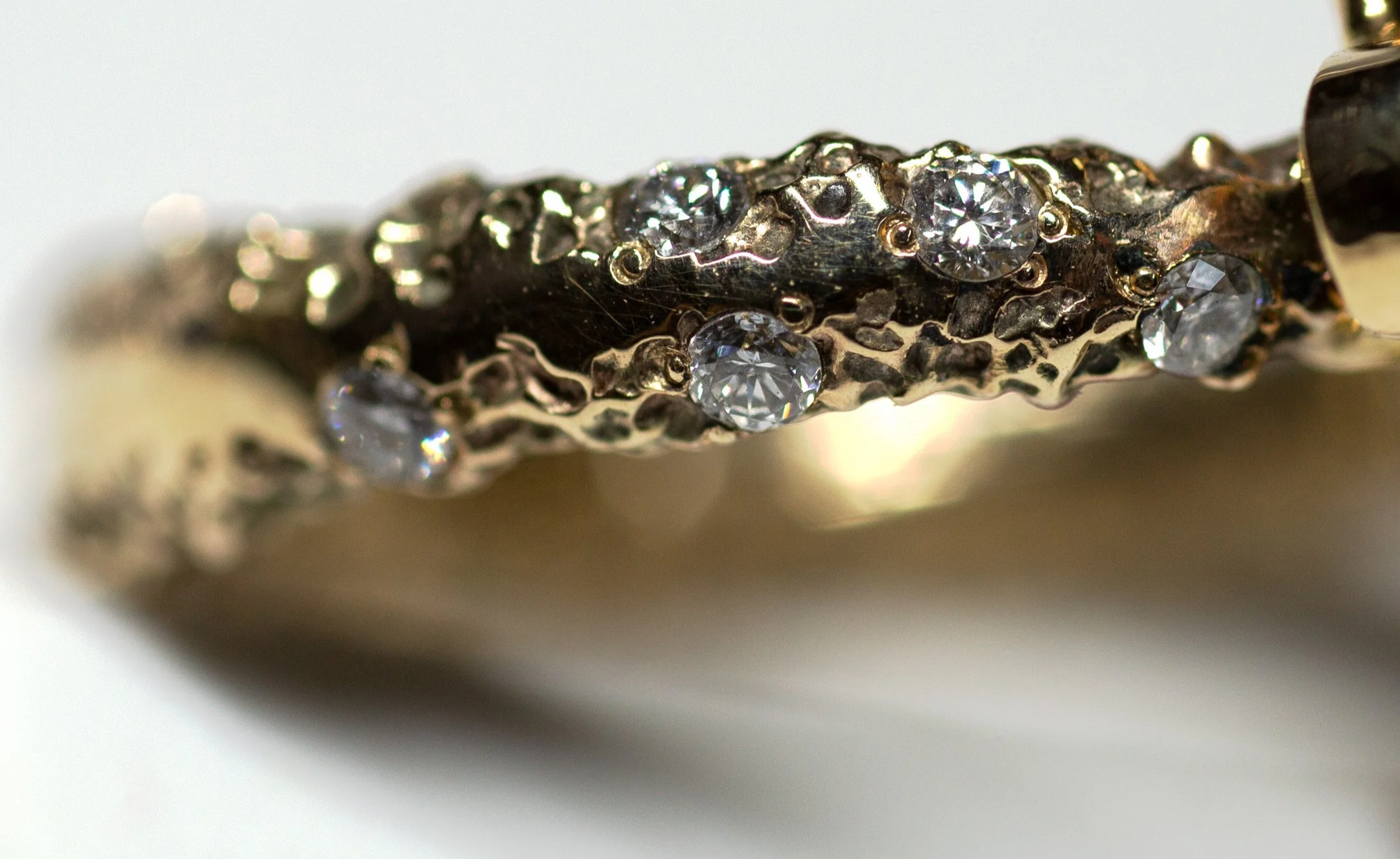
Detail of the sandcast surface with Ocean Diamonds “hidden” in the pits formed by the sand grains
Reading a Beach Like a Material
Under a lens, sand stops being a single colour and becomes a mixture. Most samples contain quartz, feldspar, fragments of shell or coral, traces of heavy minerals such as magnetite or serpentine, and in some parts of the world, volcanic glass. The proportions vary enormously, and each family of grains behaves differently against hot metal.
Quartz and Feldspar Sands: These are the classic pale beaches of long-travelled coastlines, where wave action has rounded the grains over millennia. Rounded quartz packs evenly and leaves a fine, regular stipple across the casting—closer to a softly shot surface than to a rough one. Detail holds well, contours read cleanly, and the finish is crisp without being harsh. For a first commission, this is often the most forgiving material to work with.
Shell, Coral, and Carbonate Sands: Where a shoreline is built from broken shell and coral rather than rock, the grains are more varied in size. The cast surface that follows is usually more pitted, with shallow craters where a larger fragment once sat. It reads older and softer than quartz, and it photographs beautifully in matte finishes.
Volcanic and Heavy-Mineral Sands: Black sand from basalt is younger, sharper, and more angular because the grains have not had time to wear smooth. Angular grains bite deeper into the mould face and can leave a more granular, almost fractured surface with stronger definition along edges. Heavy minerals like serpentine, concentrate in darker bands and often appear as a fine speckle in the finished texture, giving the gold a shadowed, mineral quality that suits my architectural forms.
From Shoreline to Crucible: The Sandcasting Sequence
The route from a jar of sand to a finished ring on your finger is short in description and slow in practice. Each stage protects the information held in the grains:
I dry the sand thoroughly and sieve it to remove shell fragments too large to register usefully, along with organic material that would burn away and leave voids.
I build the mould around your chosen form - whether that is an architectural band, a domed pendant, or a signet ring - packing the sand to a consistent density so the texture prints evenly.
I pour molten gold into the cavity, where it takes the exact negative of the packed surface as it cools.
I break out the casting and finish it by hand at the bench peg, removing only what is technically needed and leaving the landscape intact.
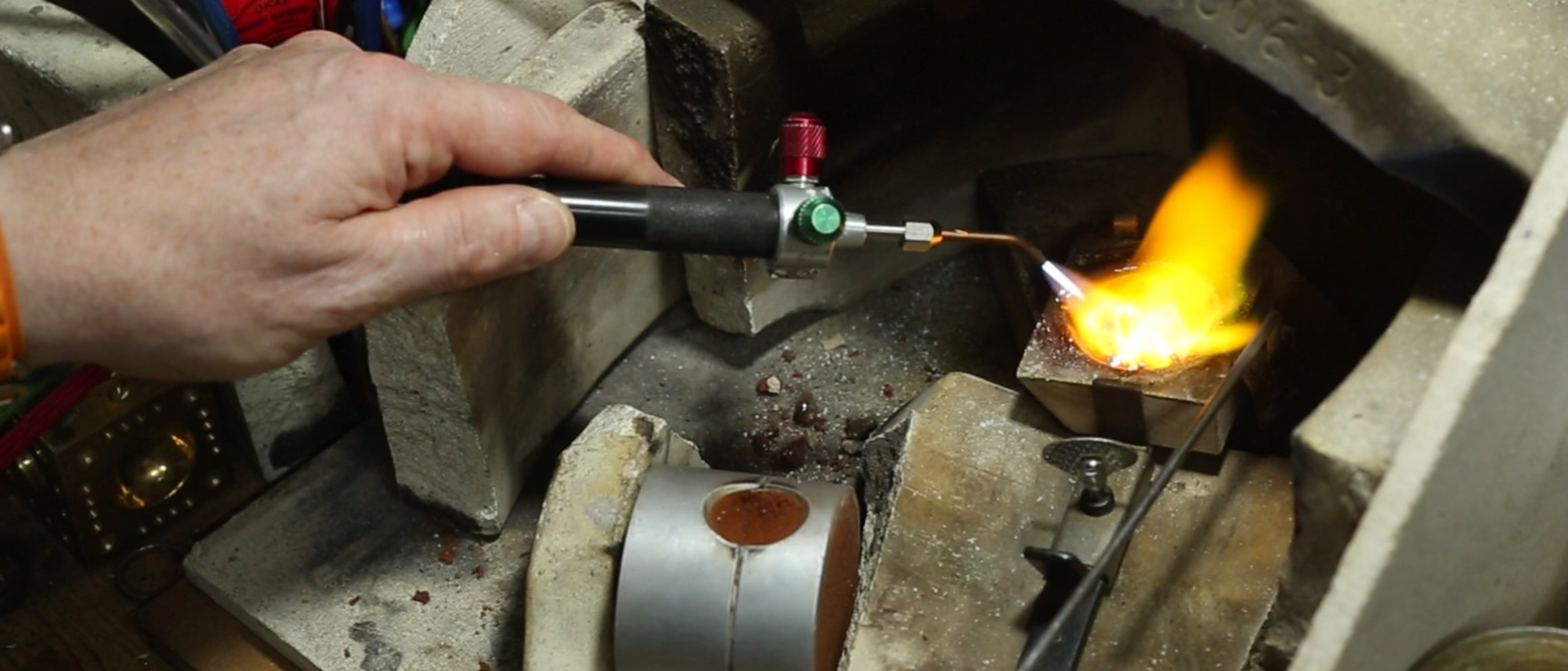
A sand mould is used once. That single-use quality is the reason no two castings are ever identical, even if I use the same mould pattern and the same beach sample twice. Occassionally the gold retains a few grains of the sand these add additional character as time, and wear, reveals them.
Contour, Coordinate, or Coastline: Choosing the Right Landscape
Some clients come with an exact point: the spot on a bridge, the corner of a field, or the precise metre of shoreline where a question was asked. Others arrive with an image, a shape: a ridgeline they have walked every year, a river bend, or the skyline from a childhood window. Both work, but they call for different bench treatments. A point suits a private mark, an inset detail, or a single strong line. Topography suits a whole surface, where a design can carry a climb from valley floor to summit.
Sand can come from any beach, track, or location that matters to you, which widens the brief considerably. A path in the Peak District, a garden here in Cambridge, a stretch of Scottish machair, and a Cornish cove all supply different grains and therefore different surfaces. My architectural collections, METROPOLIS and ATOMIUM offer structured starting points if you prefer your landscape held inside a more geometric framework.
Ethical Gold for a Piece That Carries Meaning
There is little logic in crafting a piece about provenance from metal with no traceable origin. I work in Single Mine Origin (SMO) gold, which traces the metal back to one documented mine rather than a blend of anonymous sources. The narrative that runs through an engagement ring - from landscape to sand to gold - stays coherent from start to finish.
The same thinking applies to older metal. I frequently melt down family gold and recast it so that an inherited heirloom becomes a wearable daily signature rather than sitting unworn in a drawer.
Bespoke commissions at my Cambridge studio start from £3,000, and heirloom redesign work follows the same sandcasting approach.
For fellow bench jewellers who want to master this technique, I also run an educational Patreon, The Sandcast Goldsmith, featuring complete step-by-step video tutorials.
What to Bring to Your Commission Consultation
A little preparation makes our initial conversation far more productive. Here is what helps most:
A small screw-top jar of dry sand from the place that matters, collected above the waterline where the grains are cleanest.
The coordinates and a photograph of the view, so I can see what you see rather than looking at a grid reference alone.
A clear explanation of the story, because the true design brief often hides in a single sentence about why that place is the one.
Any family gold earmarked for re-melting, along with the gemstones that need to be reset.
Very coarse gravel or wet, organic mud makes for poor casting sand, so please feel free to ask me before you commit to a sample. You can bring your jar to an in-person studio consultation, or contact me for shipping instructions if you are travelling or sending your sample from outside Cambridge.
Frequently Asked Questions
Can I use sand from anywhere, not just a beach?
Yes. Beaches are the most common source, but sand from a garden, a fell path, a dune, a riverbank, or even a personal building site can all be cast if the grains are clean and dry enough. What matters is that the place holds meaning for you, and that I prepare the sand properly before pouring.
Will shell-rich sand look different from quartz sand?
Usually, yes. Quartz tends to leave a fine, even stipple with crisp contour detail. Shell and coral grains are softer and often break down finer, producing a chalkier, more pitted surface with shallow craters. Neither is better—the right choice depends on whether you want sharp architectural definition or a softer, antique feel.
How is sentimental topography different from a coordinate engraving?
A coordinate engraving records a single point in a few crisp lines. Sentimental topography reproduces the actual surface texture of your chosen landscape in cast gold, so your piece carries the tactile character of the ground itself. It is a physical record of a place rather than a label pointing to one.