

A ring is a small object carrying an unreasonable amount of weight. It holds a date, a place, a person, sometimes a coastline you return to in your head on an ordinary Tuesday. My bespoke rings (from Iain Sainsbury Bespoke Jewellery) begin there, with the thing you want to keep, and end at my bench in Cambridge with a piece of handcast gold you can wear. I am a goldsmith rather than a retailer, and every ring that leaves the studio has been made by hand rather than specified from a catalogue and assembled elsewhere.
That distinction shapes everything about how I work. A bespoke ring is not a product with your initials added at the end. It is a conversation that becomes a drawing, then a wax or a carved form, then a crucible of molten metal and a bed of sand. The finished piece carries the marks of that route, which is precisely what makes it yours.
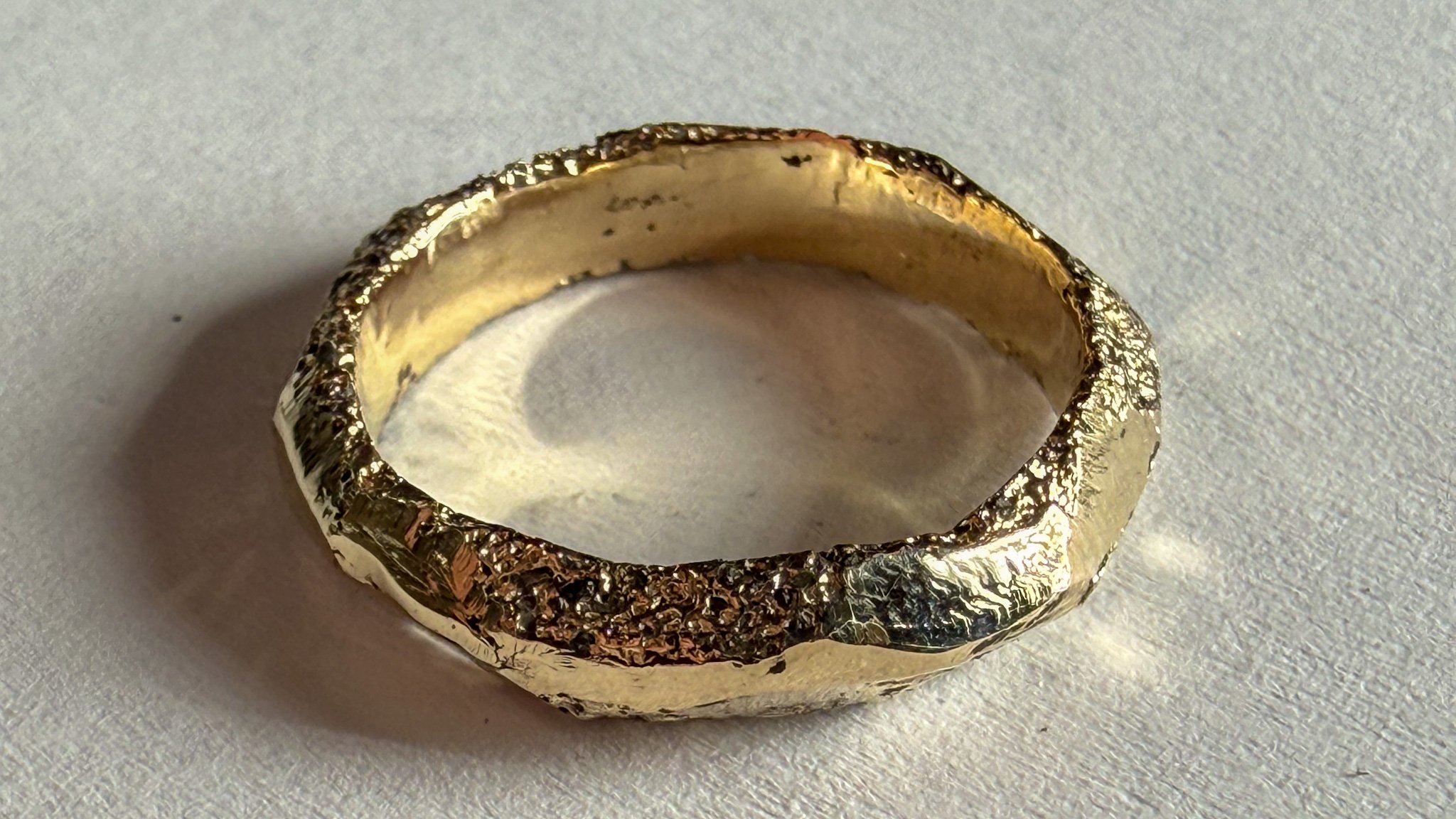
A bespoke 14ct SMO gold ring, sandcast with sand from Trevaunance Cove in Cornwall
What a bespoke ring really means
Handmade jewellery is exactly that, handmade. It is not mass produced in a factory made as cheaply as possible to maximise profit. The consequences show up in the details: a band with slightly irregular edges because a person filed them, a setting cut to fit one particular stone, a surface that records how it was formed rather than how it was polished by a machine.
I have written about this at length in the Journal, in a piece called Why choose handmade? The short version is that handwork allows decisions to be made late, at the bench, when the metal starts to tell you what it wants. A cast band that comes out of the sand with a texture no drawing predicted is not a flaw in the process. It is the process working.
Sandcasting, and why the surface remembers
Sandcasting is the technique at the centre of the studio. Metal is melted and poured into a mould formed in packed sand, and the sand leaves its own record on the surface as the metal cools. That record is the reason I keep returning to it. Delicate, granular, sometimes almost geological, it gives a ring a texture that reads as ancient and contemporary at once, and it cannot be replicated by a machine finish.
The raw beach sand texture is part of the house language, and it appears across engagement rings, wedding bands and signets. It also means no two castings are identical. Two rings poured from the same mould on different days will carry different surfaces, which is a useful thing to remember if you are commissioning a pair of wedding bands and want them to feel related rather than duplicated.
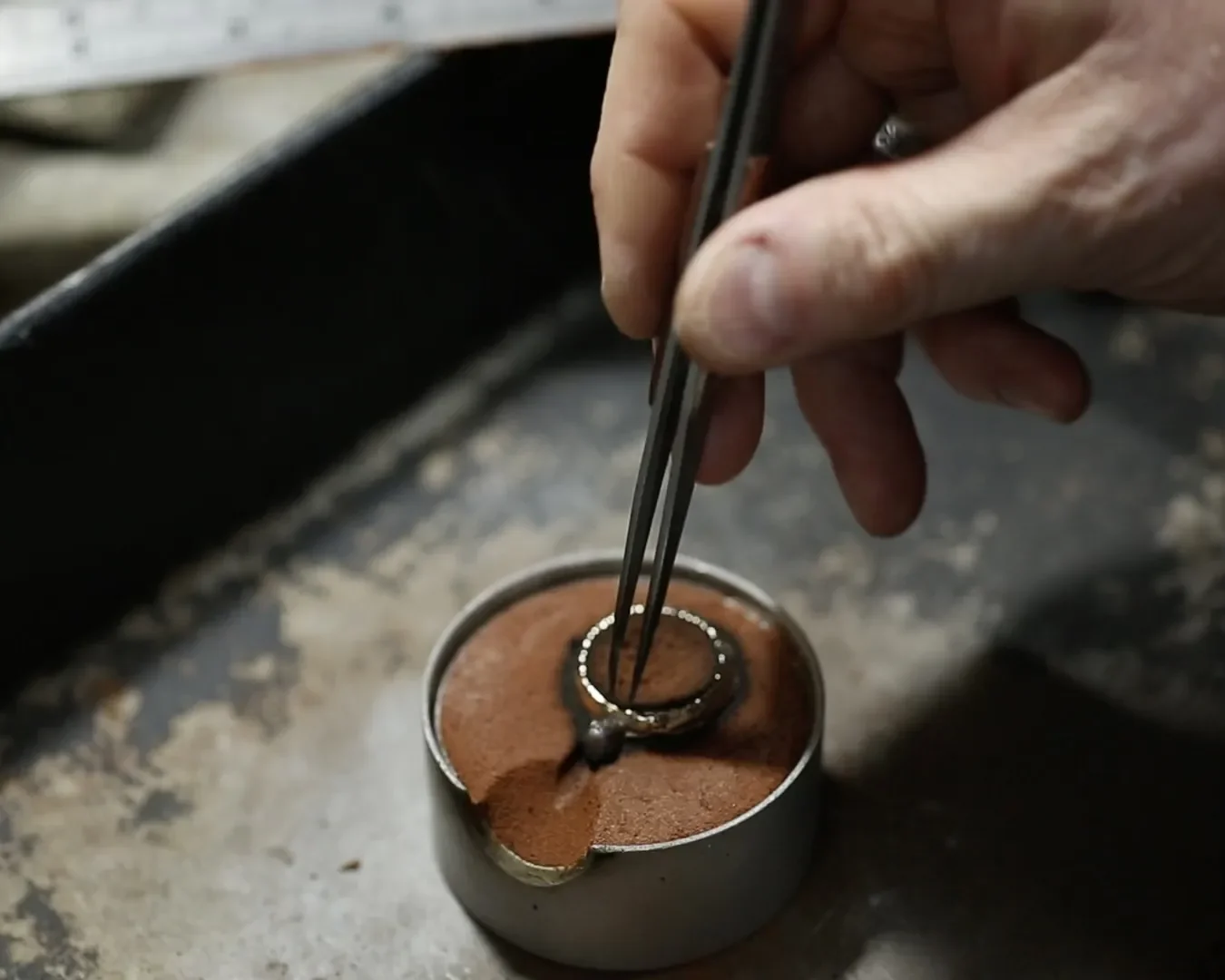
Sentimental Topography: casting a landscape into gold
Sentimental Topography is the thread that runs through much of my commission work. It is the practice of casting your personal sand into bespoke, architectural rings, so the ground of a place becomes the surface of the metal. A client brings sand from a beach where a proposal happened, or from a garden, or from a stretch of coast that belongs to a family. That sand goes into the mould.
The enquiry form opens with a line I mean literally: tell me about the horizon you wish to carry. Some people arrive with a precise coordinate. Others arrive with the faint outline of a feeling and no idea how to translate it. Both are workable starting points. The pieces that result are sculpted horizons, built with technical discipline but born from the landscapes that shaped you. You can see the wider body of work in The Atelier.
Ethical SMO gold and the question of origin
I work in SMO gold, which stands for Single Mine Origin. The point of the designation is traceability: the gold can be followed back to a single mine rather than disappeared into the anonymity of the recycled market, and buyers can ask where their metal came from and receive an answer. For clients in science, law and business who think carefully about provenance in other parts of their lives, this tends to matter.
It matters to me for a simpler reason. A ring made to mark a commitment should not carry an uncomfortable question in its wake. If the gold is traceable and the making is done by hand in a Cambridge studio, the object is coherent from source to surface. The Sentimental Topography rings are cast in 14 and 18ct SMO gold for exactly this reason, and other pieces use 14ct and 18ct white and yellow gold with sandcast bars.
Heirloom gold, remelted and reworked
Some of the most satisfying work in the studio begins with a box of inherited jewellery. Heirloom redesign means melting family gold back into a crucible and forging something new from it, often setting the original stones into the new piece. One couple wanted wedding bands with genuine history, so we reworked rings belonging to their families and forged new bands from that gold, set with stones that already had a life.
Nothing is wasted and nothing is quietly sold off. The metal that belonged to a grandmother becomes the metal on your hand, which is a different proposition from buying new gold and putting the old pieces in a drawer. It is circular in the practical sense rather than the marketing sense.
The Design Dialogue: how a commission starts
Every commission begins with the enquiry form, which I call the Design Dialogue. It asks for your name, the best way to reach you, and the landscape of your story: a location, a coordinate, a memory, or simply the shape of what you have in mind. From there we talk about metal, stones, budget and timing, and the design develops between us.
Practical questions are welcome early. If you are unsure of your ring size, there is dedicated ring sizing guidance on the site, and it is far easier to settle that before a band is cast than after. The same applies to stone choice and to the finish you want on the surface. Bring the awkward questions to the first conversation and the bench work becomes simpler.
Where the collections fit
The collections exist as starting points rather than templates. METROPOLIS and ATOMIUM each gather a set of architectural ideas, and clients often arrive drawn to one of them before the conversation moves somewhere more personal. A ring that begins near the Art Deco language, for instance, can end up carrying a coordinate from a harbour wall.
That is how bespoke work should behave. The collection gives you a vocabulary, and the commission gives you the sentence. Nothing in the finished ring needs to be justified by a trend, a season or a display cabinet. It needs to be right for the person wearing it, and for the story it is holding.
What a commission costs
Bespoke gold commissions start from £3,000, and silver commissions start from £1,500, depending on design and materials. The final figure reflects the metal, any stones and the hours at the bench, so a quote follows the conversation rather than preceding it. You will always have a clear figure before work begins, and there is no obligation attached to an initial enquiry.
If you want to follow the making side more closely, I also run an educational Patreon, The Sandcast Goldsmith, with full bench tutorials. It is there for fellow jewellers and for clients curious about what happens between the drawing and the finished ring. Either way, the invitation is the same: describe the horizon, and we will find the ring inside it.
Frequently Asked Questions
How much do Iain Sainsbury bespoke rings cost?
Bespoke gold commissions start from £3,000, and silver commissions start from £1,500, depending on the design and the materials you choose. A final figure reflects the metal, any stones and the hours at the bench, so the quote follows the conversation rather than preceding it. Send the outline of your idea through the enquiry form and you will receive a clear figure before anything begins.
Can you use sand from a place that matters to me?
Yes, and it is the reason Sentimental Topography exists. You can bring sand from a beach, a garden or another location that carries meaning, and I will use it in the casting so the metal takes its texture. The finished ring keeps a physical record of that ground, held in 18ct SMO gold.
Can you redesign an inherited ring?
Heirloom redesign is a regular part of the studio. I have reworked inherited rings for couples who wanted wedding bands with genuine history, forging new bands from family gold and setting them with stones that already belonged to the family. The original metal and stones stay inside the story rather than being sold on or left in a drawer.
Do you work in metals other than gold?
Gold is the core of the work, including 18ct SMO gold for Sentimental Topography pieces and 14ct white and yellow gold rings with sandcast bars. Silver commissions are also available and start from £1,500. The metal follows the design and the way you intend to wear the ring.
How do I find my ring size?
There is dedicated ring sizing guidance on the site, which sets out how to establish your measurement before a commission proceeds. Sorting this out early is sensible, because it is far easier to settle a size before a band is cast than after. If anything is unclear, raise it during the initial conversatio