

A sand cast engagement ring is a piece of jewellery that remembers where it was made. The sand that shaped it is gone by the time the ring reaches your finger, broken away once the gold has set. What survives is its print: a granular, uneven, softly pitted surface that no file or applied finish can imitate. For couples who want a ring that feels found rather than manufactured, that exchange of sand for gold is the whole appeal.
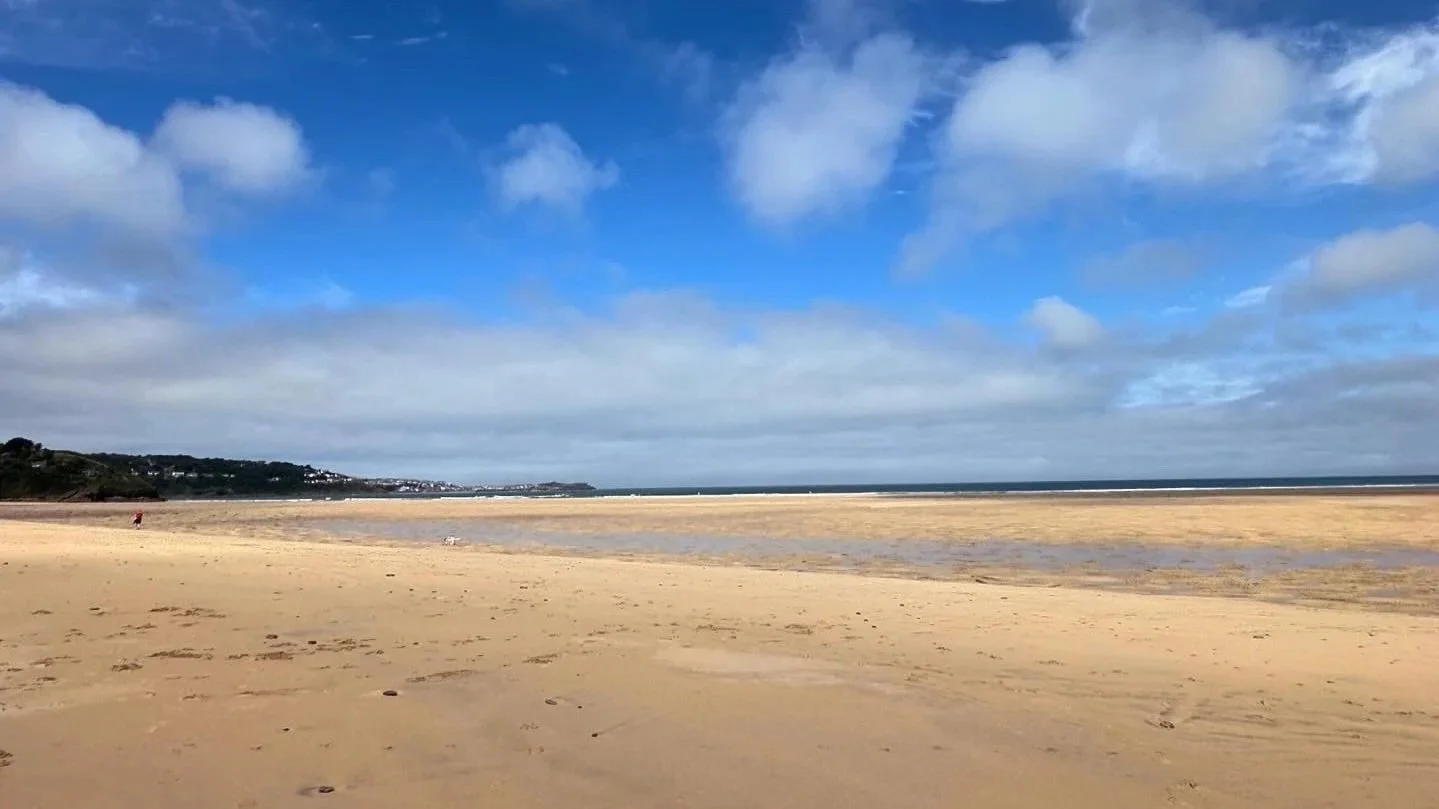
Porthkidney (Lelant) Beach in Cornwall, the sand from this beach is used in pieces from the METROPOLIS collection
What Sand Casting Actually Means
Sand casting is one of the oldest ways of shaping metal. Instead of carving a mould from wood or steel, the mould is packed from sand. A former or pattern, which might be a turned wooden ring, a forged metal shape or a hand-carved wax model, is pressed into the sand and withdrawn, leaving a cavity in its shape. Molten metal is poured in. When it sets, the sand is broken away and the ring emerges wearing the texture of the mould that held it.
The important word is broken. A sand mould is used once. There is no second casting from the same cavity, which is why a sand cast ring cannot be duplicated exactly, even by the person who made the first one. That single-use quality is the source of both the technique's charm and its unpredictability.
An Ancient Technique, Still on the Bench
Sandcasting has been used to shape metal since the early Mesopotamian era, however the earliest known sand cast rings were made in ancient Egypt around 3000 BCE, in a range of metals including gold. The method has survived for five thousand years because it does something few other processes can: it lets the material record the making. Contemporary goldsmiths use it for exactly that reason. Makers who work this way describe each piece as individual and impossible to repeat, and that is less a sales line than a description of the process.
How Beach Sand Becomes the Surface of Gold
The transformation happens in a sequence of fairly ordinary, straightforward steps. What is unusual is how directly the sand's own character travels into the finished metal.
Collecting and preparing the sand. Beach sand is dried and prepared so that it will hold a shape when packed. Grain size and grain shape vary from beach to beach, and that variation ends up in the gold.
Making the pattern. A ring form is made, either turned to size or carved by hand. The pattern formed by the impression of this ring is the negative of it, so every mark on it will appear, reversed, in the cast surface.
Packing the mould. Delft clay (a mineral oil/red sand mix) is mixed with the prepared sand, and pressed into casting rings. The pattern is pressed into the prepared surface and carefully withdrawn. The cavity left behind holds the shape of the ring and the texture of the sand around it.
Pouring the gold. Metal is melted and poured into the cavity. It fills the gaps between the individual grains, which is where the fine stippled surface comes from.
Breaking out. Once the metal has cooled and set, the mould is broken apart. The ring comes free wearing a surface no one designed or could replicate by hand.
Cleaning and finishing. Finishing is a series of choices rather than a single stage: how much texture to keep, where to polish, whether the inside of the band is smoothed for comfort while the outside stays raw (in general I polish out surfaces that contact the skin, for comfort).
Setting stones. If the ring will carry stones a forged setting is created and added or stones added directly to the cast surface, the setting either works with the cast surface, blending with the texture rather than flattening it or a setting is added, retaining the texture.
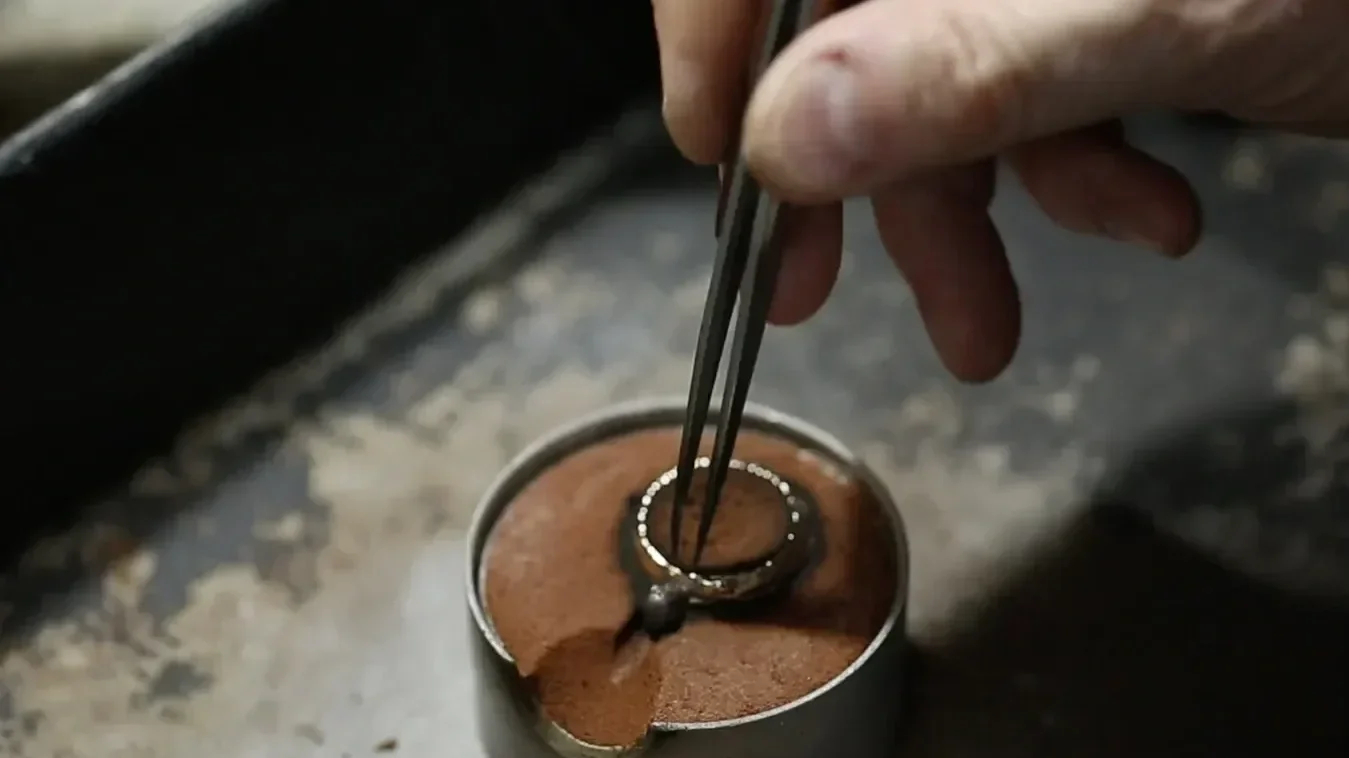
Once cooled a gold ring is removed from the burnt mould.
The Surface Is a Record, Not a Finish
Most jewellery is finished towards uniformity. A sand cast ring is finished towards the opposite: the goal is to keep as much of the cast character as the wearer wants, and to remove only what comfort or durability demands. Textures run from a fine, almost stippled grain to a deeper, rock-pool pitting, depending on the sand, the pattern and the amount of work afterwards.
This has a practical consequence for couples. Two rings cast from the same beach will not match, and a pair of wedding bands will read as siblings rather than twins. Some people love that. Others find it difficult to accept without seeing the surface in person, ideally on a ring that has already been worn for a while.
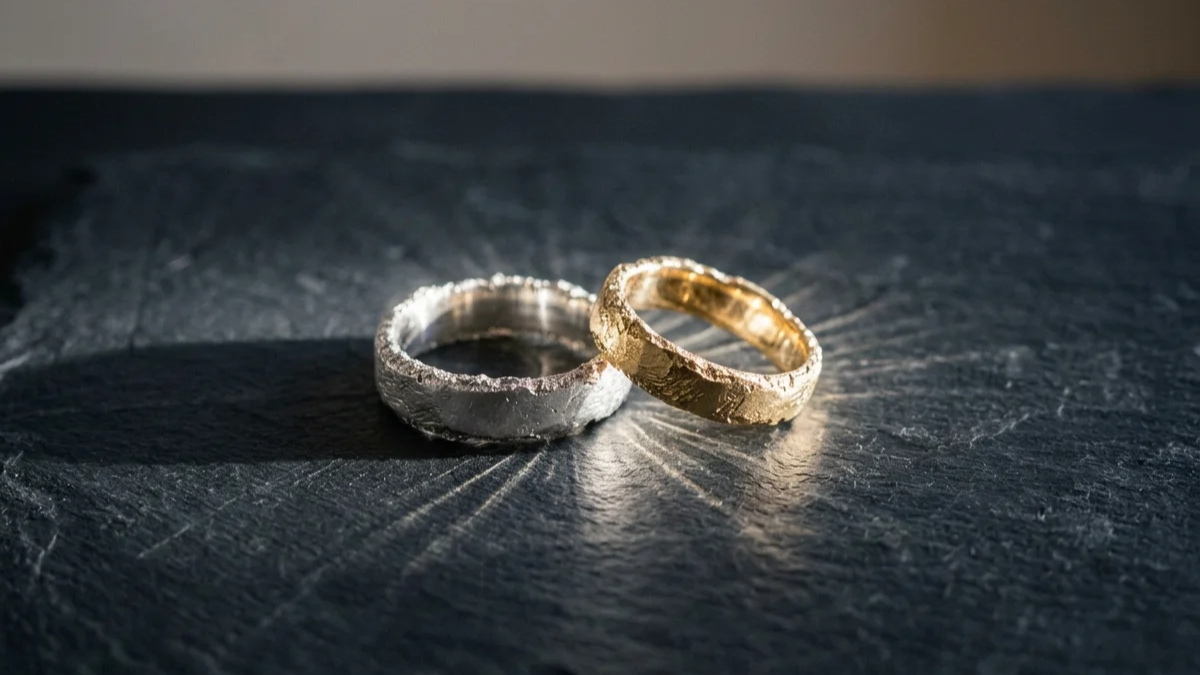
A pair of white and yellow goldsdandcast rings. Similar, but not identical.
Choosing the Sand
Some makers have libraries of sand and will cast in a sand of your choice. I make one of a kind pieces in sand collected from places I know and love, most of them in Cornwall, where I grew up. These sands are available for private clients to choose, however many clients prefer to send sand from a place they love and this is wonderful the sand comes from a beach that already means something, and it will be carried forever in gold.
A few practical points are worth thinking through. A small quantity of sand is enough, but it is wise to bring back more than you expect to need, since some is lost in preparing the mould. Check that collecting a small amount is permitted at the place you have in mind, especially island locations as some prohibit this by law. And expect the sand to behave differently depending on whether it is fine or coarse, dry or dusty, which is part of what makes the finished surface specific to that one stretch of coast.
Gold, Provenance and Old Metal
People drawn to sand casting tend to care where the gold came from as much as how it was shaped. Single Mine Origin gold, which traces metal back to a single mine, is one route. Ocean Diamonds, recovered from the seabed rather than mined from the ground, suit the coastal logic of a sand cast piece. Palladium white gold alloys offer a paler alternative without the same reliance on rhodium plating.
Sand casting also lends itself to old, heirloom gold. Sandcast wedding bands perfectly suit family gold, it can be worked into a new form and set with heirloom stones, so that the precious material stays in the family with a new life. The texture augments this, an honest raw surface, which suits metal with a history.
Designing for Texture: Width, Profile and Stones
Sandcast surfaces feel and look qute different with varying widths. A 7mm band gives the grain room to show and feels substantial on the hand; a narrower band tightens the texture into something finer and quieter. Profile matters too, since a flat band catches the grain evenly whilst a domed band stretches it around a curve.
Stones can be set into the surface highlighting texture rather hiding it. Setting into roughness takes more time than setting into a polished face, because every seat has to be cut through an uneven surface and the stone protected without flattening the character around it.
As a general rule I would advise against casting stones “in place” as this can easily lead to failed castings and can damage stones (even sapphires and diamonds) with the heat shock.
What a Sand Cast Engagement Ring Costs
Prices vary with metal, stone and complexity. Commission work is quoted individually, so please ask for a written breakdown covering metal, stone, setting, sizing and the timetable, and confirm current prices directly with any maker before committing.
Questions to Ask Before You Commission
A good commission starts with a conversation rather than a photograph. These are the questions worth putting on the table early.
Can I see a sandcast surface in person, ideally on a worn ring rather than a new one?
Which beach sand are we using, and how much should I bring?
How much texture will survive the finishing, and where will the ring be polished smooth?
Can the ring be resized later, given the width and any stones in the band?
What happens to the surface as it wears over ten or twenty years?
Is the gold Single Mine Origin, recycled, or my own metal sent for refining?
Frequently Asked Questions
Can a sand cast engagement ring be resized later?
Sometimes, but not always easily. Resizing depends on the band's width and texture, whether stones run around the shank, and how the surface would be interrupted by cutting and rejoining. Ask your goldsmith before you commission, and mention it again during the design conversation, so the ring is built with a little future flexibility in mind.
Does the sand wear off the ring?
No. The sand is not applied to the ring. It is the mould the gold was poured into, and it is broken away afterwards. What remains is a texture in the metal itself, as permanent as the ring. Over years of wear, high points may polish slightly and the surface may soften, which many people find an improvement rather than a flaw.
Can I use sand from a beach that matters to us?
Often, yes. Makers who work this way commonly offer casting in a sand of your choice, and a proposal on a particular beach is a frequent request. Ask in advance, check that taking a small amount is permitted, and bring back more than you think you need, since some will be lost in preparing the mould.
Will our two rings match exactly?
No, and that is the point. A sand mould is destroyed when the ring is released, so no two casts are identical. A pair made from the same sand will read as siblings rather than twins, sharing grain and character but differing in detail. If you want a matched pair, look at the two surfaces together before the final finish is agreed.
Is a sand cast ring suitable for everyday wear?
Yes, with sensible design. Gold is gold, whatever the surface, and a well-made band will take daily wear. The practical considerations are width and stone setting rather than texture: a slightly wider band and a protected setting suit hands that work hard. Discuss your daily habits with the maker and let the design answer them.