The first thing that strikes most people at a sandcast bench is how little of it looks like traditional jewellery making. There is no tidy row of burnishers, no pliers and no wax carving tools in sight. Instead, there are rulers, a hammer, a rammer, a flask, a crucible, tins of sand and a torch with an adapted nozzle wide enough to melt gold in under a minute. In this environment I pack sand around a pattern, withdraws the pattern, and pour. The molten gold takes the exact shape the sand remembered.
Sand casting is a metal-casting process in which a single-use mould is packed in sand, or a clay-bonded sand mixture, around a pattern, and molten metal is poured into the cavity left behind. It is a millenia-old technique, with early examples of rings found in ancient Egypt, and it survives on modern benches because nothing else records organic texture quite so directly.
Outlined in this article is what the tools do, how a mould is built, and why compression is the quiet decision that determines whether a piece emerges with crisp tactile grain or with sand welded into its shoulder.
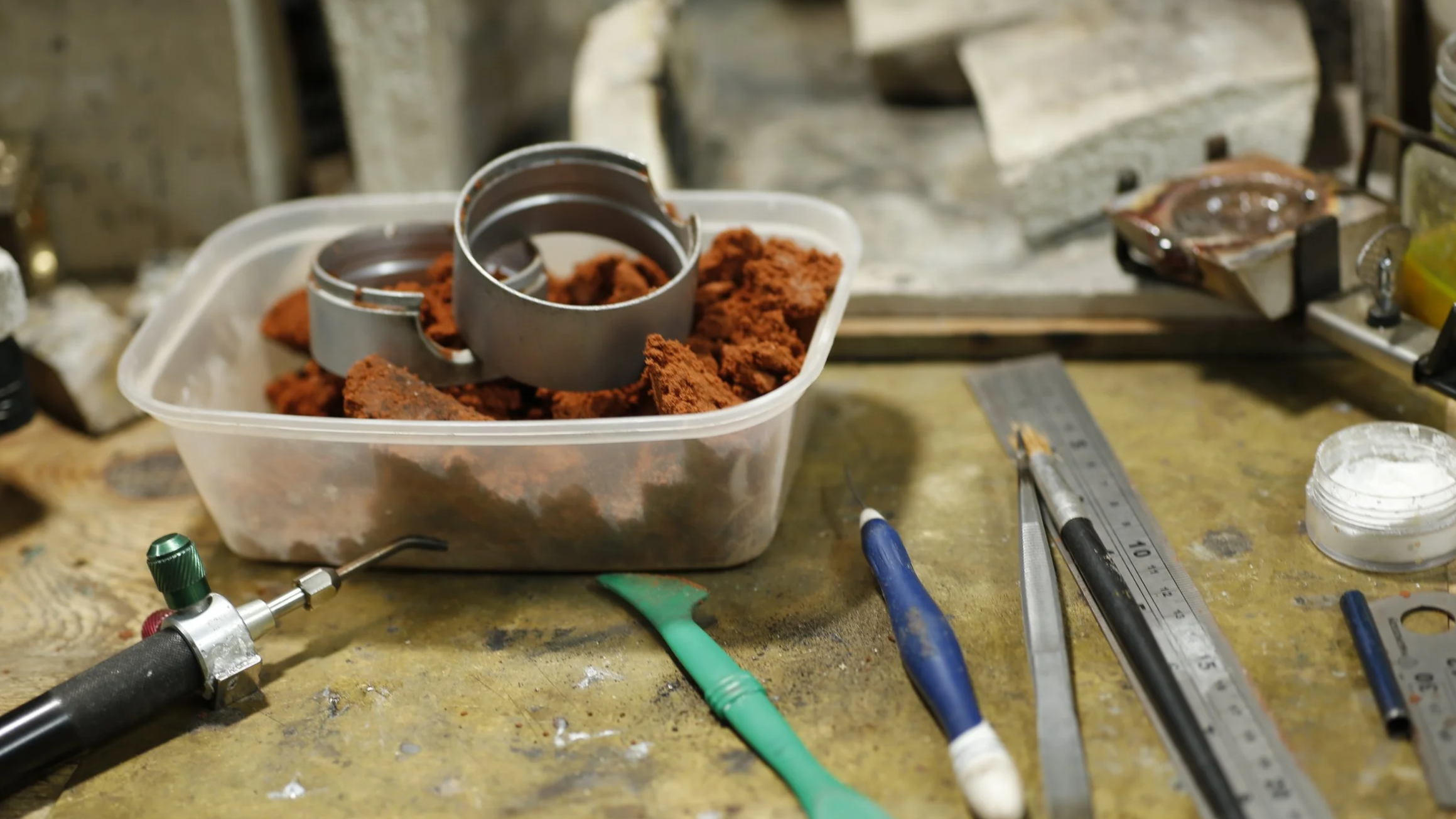
My Cambridge goldsmith sandcasting bench showing two-part casting flask, Delft clay, torch, crucible and tools of casting.
The Tools That Do the Real Work
Sand Preparation Kit
Sand casting begins long before any gold is hot. Fine sand and mineral oil-bonded Delft clay, forms the usual base for my fine jewellery work. The clay content gives the sand enough green strength to hold a sharp cavity once the pattern is withdrawn. On my bench, that requires careful preparing or “cutting” with a steel edge to break up lumps and remove debris, and airtight containers so sand that performed reliably last week has not absorbed a fortnight of Cambridge humidity in the meantime.
The Flask,the Rammer and the Hammer
A flask, sometimes called a casting frame, is the open-sided metal box/tube that holds the packed sand. A two-part flask lets you build the mould in halves so you can separate them and withdraw the pattern without destroying the cavity. The rammer is the tool that does the most consequential work on the bench—for me a rod of hardwood, the hammer that gives the final compaction. Cornflour, a paintbrush, clay shaping tools and a fine wire tool complete the set. None of it is expensive. All of it is precise.
Melting and Pouring Gear
For bespoke commissions, I melt 18ct Single Mine Origin (SMO) gold (or 14ct/Sterling Silver) in a ceramic crucible using an Oxy-Propane torch, transferring it to the flask once molten. Flux keeps the melt clean and free from oxides. The safety kit matters just as much as the casting kit: bone-dry sand only, never a damp mould, alongside a eye protection, heat-resistant apron and active extraction ventilation. A steam explosion from trapped moisture is not a hypothetical risk, and no ring is worth it.
The Mould Is the Sand, and the Sand Is a One-Off
In most commercial jewellery production, a rubber mould is injected with wax hundreds of times, and every piece cast from it is identical. Sand casting works the other way. The mould is packed fresh for each commission and broken apart afterwards, which is why sandcast gold jewellery never has an identical twin. Each surface is an original physical record of how individual grains sat against the molten metal.
Two Halves, One Seam
Sand is packed in the first half of the flask, rammed/hammered and the surface is dusted with separating medium (cornflour). The pattern is pressed into this surafce, and the second half is registered on top, packed and rammed.The two halves are separated to release the pattern and a tapered sprue channel is cut so molten metal can reach the cavity. Small gates and air vents are added. Everything is done to ensure the molten metal flows freely around the mould. When the pour happens, gold enters through the sprue and fills the cavity—meaning the displaced air needs an immediate escape route. That is the vent's job, and it is where compression and permeability begin to negotiate with one another.
Sand with a Place in It
Alongside my studio archive of coastal sands from Cornwall and other favourite locations, clients regularly send sand from shorelines, mountain paths, gardens and landscapes that hold personal meaning—a bespoke process I call Sentimental Topography. Rather than applying a decorative finish after the fact, the physical landscape becomes the mould itself. Personal sand behaves differently from a prepared foundry mix, which is where metallurgical judgement comes in: reading the grain size, testing a small sample, and adjusting how firmly it needs to be packed.
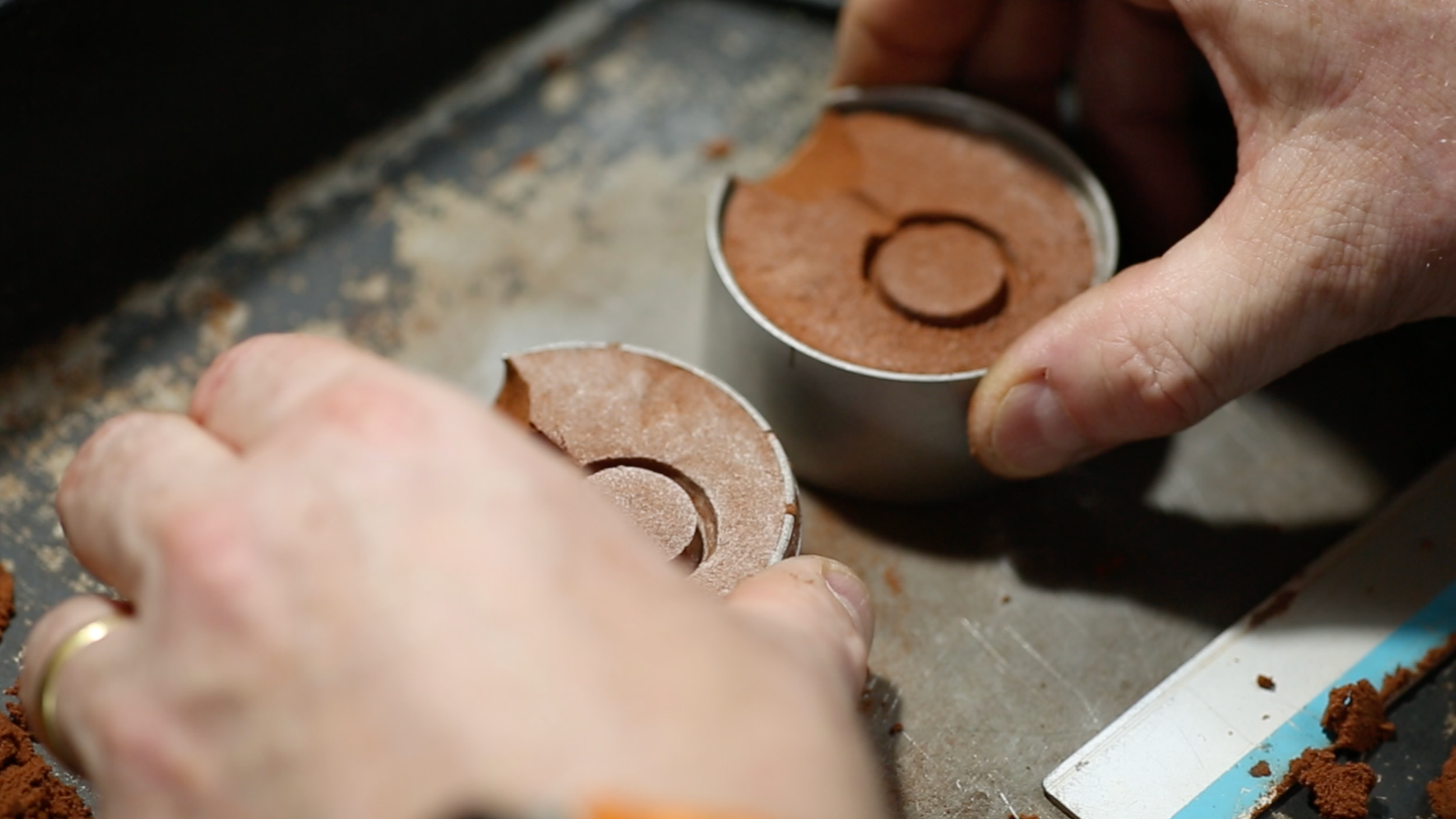
Packed Delft clay sandcasting mould with ring pattern impression and cut sprue channel on the goldsmith bench
Compression Explained
Compression is the heart of the entire process and the stage most often glossed over. Sand must be packed tightly enough that the cavity walls survive the weight and turbulence of molten gold, yet loosely enough that displaced gas can travel through the sand body and out of the flask. Those two requirements pull in opposite directions. Every impact of the rammer and hammer is a calibration between them.
What the Rammer Is Actually Doing
Sand goes into the flask in layers, never all at once, and each layer is tamped with steady, even pressure. Working incrementally eliminates the large air pockets that would otherwise collapse during the pour. The rammer must also press sand cleanly into undercuts and behind architectural edges without shifting the pattern out of alignment. Consistent pressure matters far more than brute force: a mould rammed hard on one side and lightly on the other will erode or fail on the soft side.
Too Loose and Too Tight
Under-rammed sand is weak sand. The cavity walls can slump or wash away when dense molten gold hits them, leaving sand inclusions, a ragged edge or a casting with a section missing. Over-rammed sand is overly dense, and dense sand cannot breathe. Gas that cannot escape through the permeable mould walls forces its way back into the cooling metal instead, producing internal porosity, rounded blowholes and a blistered surface. The sweet spot is firm, uniform and breathable, judged by hand, experience and repetition rather than a dial.
Venting as a Compression Tool
Venting gives compressed sand a controlled escape route. A fine steel wire is used to push from the cavity edge through to the outside of the flask, creating narrow channels for air and gas. On a wide or heavily textured band, the venting pattern becomes even more critical, because the same deep grain that holds character also traps air. When a casting shows porosity in one predictable spot, the fix on the bench is almost always an extra vent or a slightly lighter ram in that zone, not a different alloy.
From the Pour to the Bench Peg
The gold is melted, fluxed and finally poured in one steady, uninterrupted motion. Once the flask has cooled and the metal has solidified, the sand is broken away and the raw casting is released with its sprue still attached.
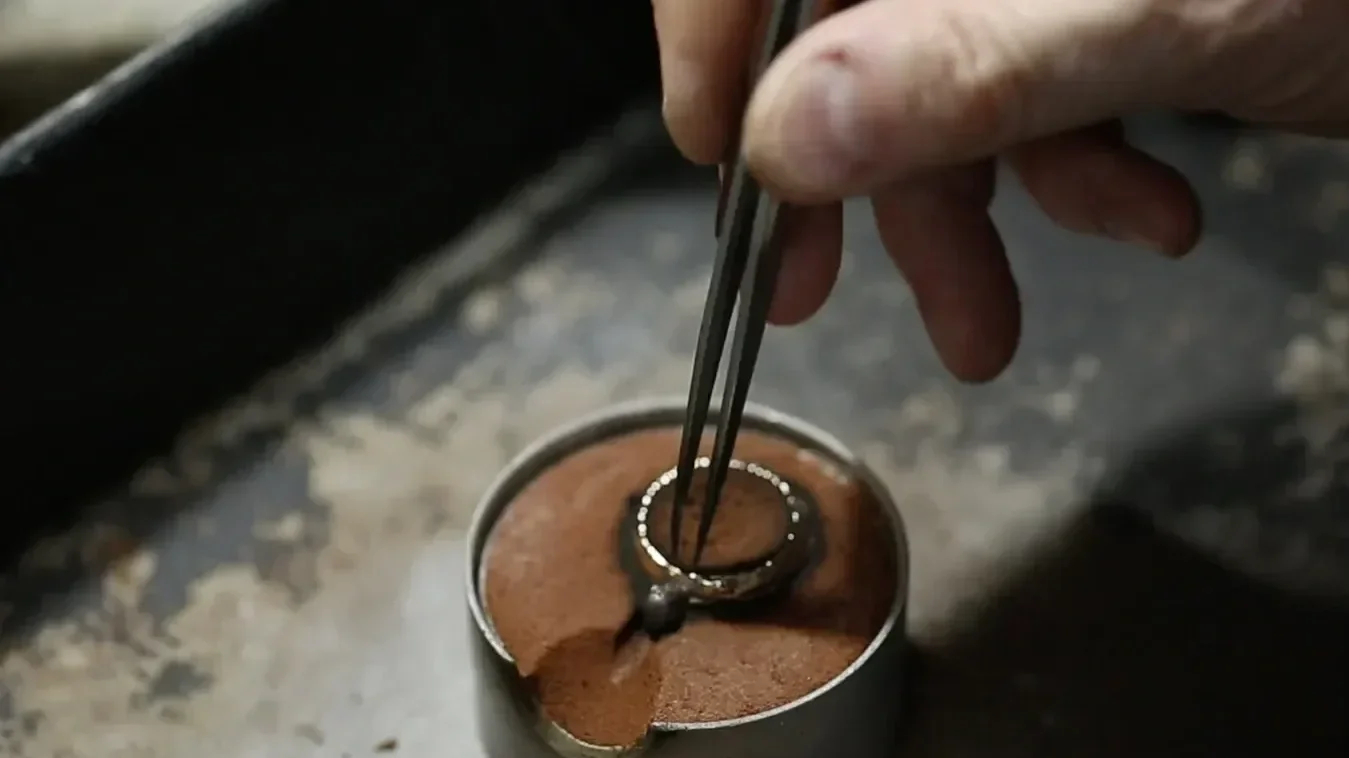
Raw 18ct gold sandcast ring freshly broken out of a single-use sand mould in Cambridge
After cutting off the sprue and pickling the metal to remove surface oxides, finishing begins—and this is where restraint matters most. Files and emery paper can erase raw sand texture in seconds, so every stage is planned around which surfaces stay untouched and which edges are trued up for comfort and architectural clarity. Where a design calls for diamonds or coloured gemstones, crisp settings are fabricated separately and soldered onto the verified band so the stones sit securely without flattening the surrounding cast grain.
What Sand Casting Will Not Do
Sand casting is not a uniform manufacturing process. Fine, razor-sharp detail is naturally softened by the mineral grain,and identical repeat production is impossible by design. Delicate claws and crisp geometric collets are far better hand-forged at the bench and integrated after casting, combining the raw honesty of sand with clean architectural precision. Anyone expecting the sterile uniformity of mass-produced lost-wax casting from a sand mould will be disappointed. Anyone wanting a heavy-gauge ring with a surface that could only have been formed once, in that flask, on that morning, will not be.
Look closely at a sandcast ring and you are seeing a sequence of physical decisions made across a few square feet of bench: which sand, how dry, how fine, how firmly it was compressed and where the gas was allowed to escape. That is the craft, and it is why no two pieces ever leave the flask the same.
Frequently Asked Questions
Is sand casting still used today?
Yes. Sand casting remains an active, specialised technique on contemporary goldsmithing benches rather than a historical curiosity. At my Cambridge studio, I use it to craft bespoke rings, signets and pendants in 18ct Single Mine Origin (SMO) gold, 14ct gold and silver—chosen specifically for its unrepeatable organic texture and substantial feel on the hand.
What are the downsides of sand casting?
The process is deliberately non-uniform. Ultra-fine details soften into the sand grain, identical repeats are impossible, and porosity or sand inclusions can occur if compression and venting are misjudged. Because each mould is destroyed after a single pour, there is no reusable master mould, meaning every piece demands concentrated bench preparation and metallurgical judgement.
Can I send my own sand to be cast?
Yes. Many clients send sand collected from a meaningful beach, coastline, riverbed or mountain path so that a specific place is permanently recorded in gold. Because mineral grain size and clay content vary widely from location to location,I always inspect and test a small dry sample first. Get in touch before collecting so I can advise on sample quantities and local collection guidelines.
Does compression really change the finished ring?
It governs almost everything about the integrity of the cast. Under-packed sand leads to weak cavity walls and surface inclusions, while over-packed sand traps gas and causes porosity. Even, layered ramming paired with deliberate venting produces a clean fill and the crisp, eroded mineral texture that defines fine sandcast jewellery.