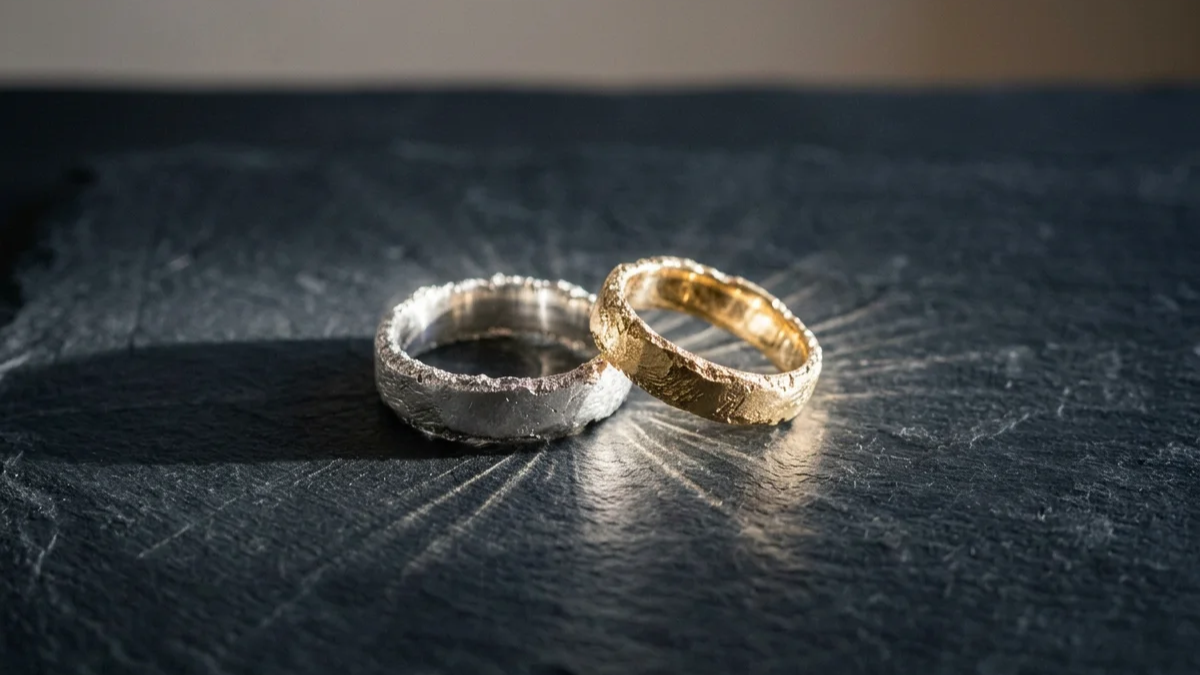
Sandcast 18ct wedding ring pair in white and yellow gold
Inside my Cambridge workshop, a pair of wedding bands begins the same way a single ring does: with a conversation about what you will both still want to wear in fifty years. What changes with a pair is the relationship between the two rings. One band made on its own can be any width, any curve, any texture. Two bands made together have to agree with each other.
Sandcasting gives that agreement a particular character. Each ring surface is a direct record of the sand it was poured into, so the texture on your band is not applied afterwards, it is born in the mould. When two bands come from the same bench, worked in the same session of carving, pouring and finishing, they carry a shared fingerprint rather than just a shared design.
Why a Pair Should Be Designed Together
Working directly with the goldsmith who will pour and finish your rings matters, because a wedding band is one of the few objects in life where the maker's hand remains permanently visible. Whether couples visit my Cambridge studio in person or collaborate via virtual consultations with insured sample sets sent nationwide, designing both rings together allows us to judge proportion side by side rather than in theory. The practical reason to design a pair together is proportion. A 4mm band on one hand and a 2mm band on the other will look mismatched unless the difference is deliberately echoed in the profile or the finish. Two people with very different hands, one broad and one narrow, need a design that reads as a set without forcing identical widths on both. Working with both rings on the bench at once makes those judgements visible rather than theoretical.
It is also common for couples to bring existing metal into the process. A grandmother's ring, a father's band, two family rings melted together: jewellers across the UK routinely take heirloom gold and rebuild it into a new bespoke band, preserving the material while changing the form. If you are considering that route, ask directly how much of the original metal can be used and whether the alloy needs adjusting, since old gold is rarely a known specification.
What Matching Actually Means
Matching does not have to mean identical. There are three broad approaches worth discussing before any sand is touched.
Identical - Same width, same profile, same finish, scaled to each hand. The most traditional reading of a matched pair, and the one that relies most heavily on the sand texture being consistent between two pours.
Related - One shared element, usually the profile or the surface, with a difference in width. A 5mm band beside a 3mm band in the same hammered finish still reads as a pair.
Echoed - A single detail repeats across both rings, such as a softened inner curve, a slight chamfer on one edge or a line carved into the sand. Subtle, and only visible up close.
The choice usually becomes obvious once you hold two sample rings in different widths. Something that looks balanced in a photograph can feel heavy on a finger, and a narrow band next to an engagement ring with a large setting may need a different profile so the two sit comfortably together.
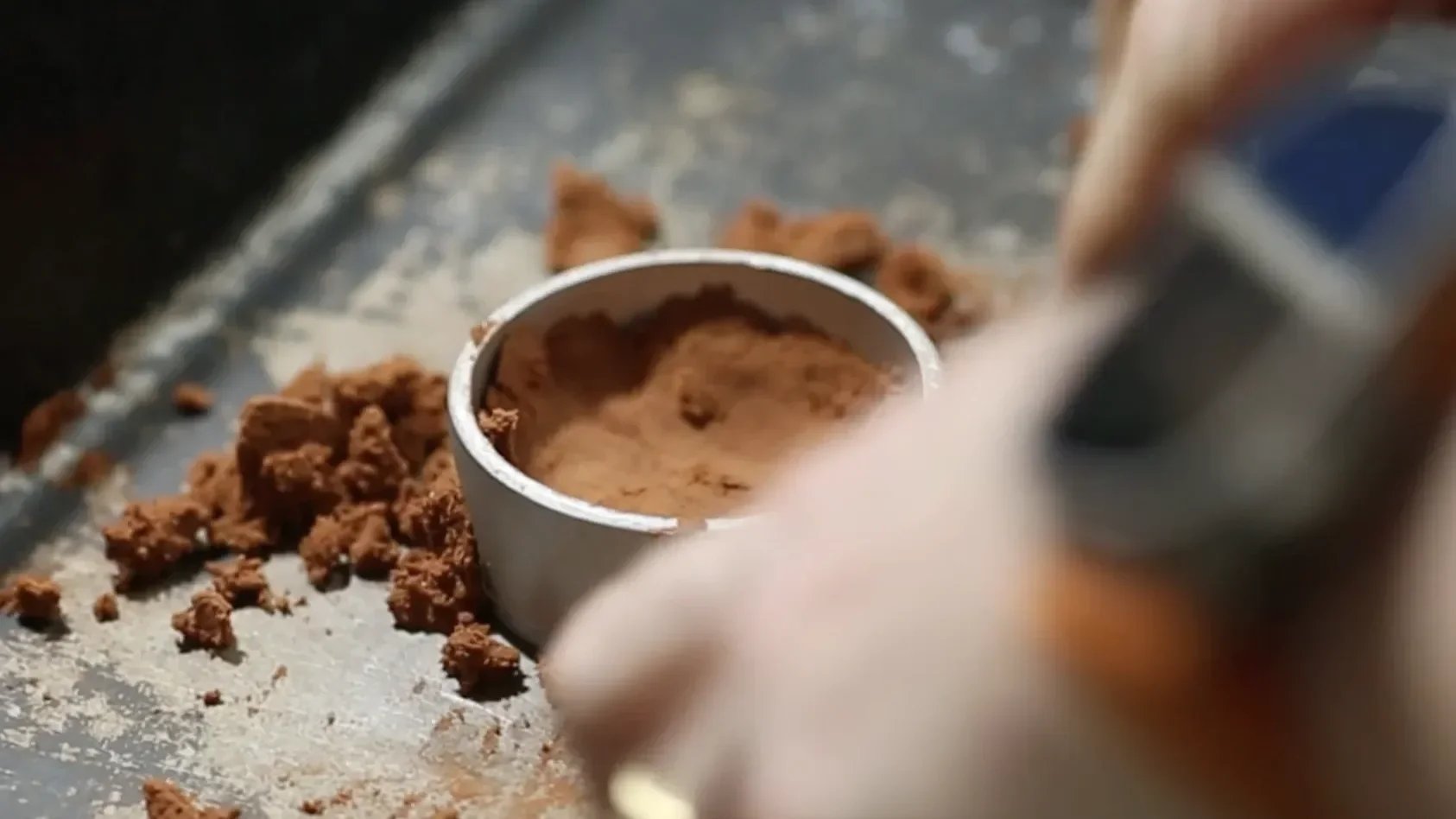
Creating the mould for the rings in sand
The Sandcasting Process, Step by Step
Preparing the sand
Sandcasting uses sand as the mould itself, not as a disposable support. The sand is packed and worked so it holds a shape precisely, and the surface quality of that sand becomes the surface of the gold. Any grain, ridge or pressed mark will survive the pour. This is why the technique rewards patience at the start and why two rings cast for the same pair are prepared side by side, from the same batch, so the texture is consistent. Couples can choose from my curated archive of coastal sands, many from my favourite beaches in Cornwall, or supply sand gathered from a shoreline or landscape that holds personal meaning - a process I call Sentimental Topography, capturing a shared geographical memory inside both rings.
Carving or pressing the pattern
The pattern is formed in the sand, either carved by hand or pressed from a model. For a matching pair, this is the point where decisions about width, edge hardness and inner curve are locked in. A slightly rounded inner edge and a softened outer edge are common choices for wedding bands, since they are worn every day and comfort matters more than a crisp line.
Pouring the gold
Molten gold is poured into the prepared mould. The metal takes the shape of the cavity and, crucially, the finish of its walls. The moment of the pour is short; the preparation behind it is not.
Cleaning up and finishing
Once cooled, the casting is cut free, cleaned and refined. Finishing is where a matching pair is either confirmed or quietly lost. Each ring is filed, emeryed and polished or left textured, and the two are compared constantly under the same light. The aim is not to erase the sand, but to decide how much of it to keep.
Choosing the Gold
My work is built around Single Mine Origin gold, which allows a couple to trace the metal back to a specific mine rather than accepting a generic recycled claim. Provenance questions come up more often now than they did a decade ago, and being able to answer them plainly is part of the service rather than a marketing layer on top of it.
Yellow SMO gold in 18ct is the mainstay of wedding rings. The difference is as much about colour and wear as about purity: 18ct is deeper in tone and softer under the file, 14ct is a little more restrained in colour and more resistant to everyday knocks. For white metal, high-palladium alloys offer an alternative to rhodium-plated white gold, avoiding the re-plating cycle that plated rings need.
In general I do not work with platinum as sandcasting is not possible as it melts at a higher temperature than most sand (silica). In addition due to the environmental challenges of platinum extraction and lack of commercial recycling options I feel it does not align well with my workshop ethos.
Coloured stones and diamonds, can be set into a band if you want a pair that is not entirely plain, though most couples keep the wedding band simple and let the engagement ring do the talking. For diamonds I use Ocean Diamonds if couple want new sourced stones, however I also have many recovered heirloom stones which can be a good alternative.
Widths, Profiles and Finishes
These are the three variables that decide whether a pair looks like a pair. None of them has a single correct answer, but the combinations interact.
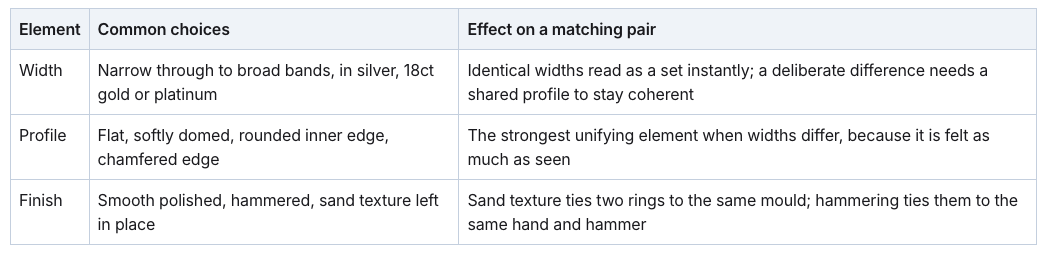
My handmade bands in precious metals are available in a range of widths and finishes, from smooth polished to hammered textures, so the real decision is not whether a finish exists but whether it suits the way you use your hands. Anyone working with tools, lifting weights or typing all day should think hard before choosing a high polish, which shows every scuff, over a textured surface that absorbs wear more gracefully.
Working with Heirloom Gold
Bringing family metal into a new pair is one of the more satisfying commissions on the bench, and one of the least predictable. Old gold arrives in unknown alloys, sometimes with solder seams, sometimes with stones still set. The honest answer is that nothing can be promised until the metal has been examined and, in many cases, tested. A conversation about what you hope the heirloom contributes, whether that is the bulk of the metal, a symbolic amount, or simply the sentiment of having it present, is the right place to start.
Where the quantity is insufficient or the alloy unsuitable, new SMO gold can be added. The finished ring then carries both a family history and a traceable present, which is a more interesting object than either alone.
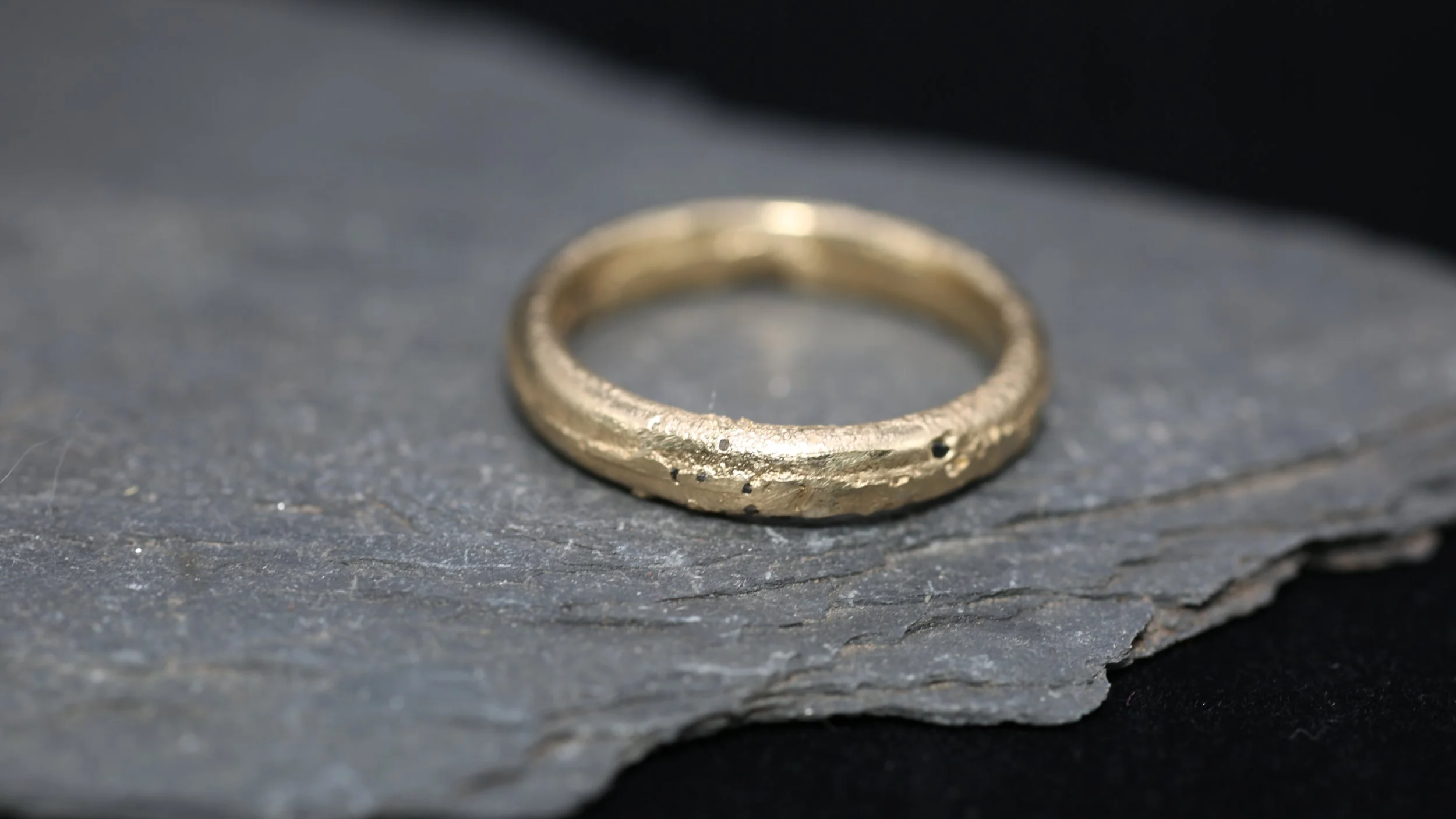
A bespoke paler 18ct alloy ring left rough with some sand grains still captured.
How a Commission Runs
Most bespoke processes begin with a consultation, in person or by video, where you talk through what you want and see samples. From there, drawings or a model are prepared, refinements are made, and the rings go to the bench. Because sandcasting is a single-event process, the pattern needs to be right before the pour; changes after casting mean starting again.
Expect to discuss sizing carefully and to allow time for it. A wide band fits differently from a narrow one, and a pair cast together should be sized individually rather than assumed to match. Ask about resizing before you commit, since some textured and stone-set designs cannot be altered easily without losing the surface. Every pair of rings leaves my bench with lifetime aftercare guidance, including complimentary ultrasonic cleaning and periodic surface inspections.
At my Cambridge workshop, bespoke sandcast wedding band pairs in 18ct Single Mine Origin gold typically start from £4,500 for the pair (and from £1,500 in silver), depending on band width, metal weight, and any stone setting. You will receive a clear written breakdown before any pattern is carved or gold is poured.
Living with a Sandcast Band
Sandcast surfaces soften with wear. The crisp grain you collect gradually becomes a gentler texture as the high points polish against clothing and skin, which most people find attractive and a few find surprising. Warm soapy water, a soft brush and a dry cloth will keep the metal clean without stripping the texture. Store the two rings separately from harder stones to avoid unnecessary scratching, and have the settings checked periodically if you have chosen a band with stones.
A matched pair made by hand will never be quite as uniform as two rings pushed out of the same machine, and that is the point. Two pours, two textures, two hands, one shared intention.
Frequently Asked Questions
Can two wedding bands really match if they are cast separately?
They can, because matching is controlled at the preparation stage rather than the pour. When both patterns are carved into sand from the same batch, with the same width, profile and texture decisions recorded, the two castings sit closely together. The finishing bench then compares them under the same light and refines until they read as a pair.
Can our rings be made from my family's gold?
Often yes, but it depends on the metal. Heirloom gold arrives in unknown alloys and may contain solder seams or old repairs, so a maker needs to examine and test it first. New Single Mine Origin gold can be added if the quantity is short. Ask for a clear explanation of what will be reused before work begins.
Is a textured finish harder to look after than a polished one?
In practice a textured sandcast finish is more forgiving, because scuffs and small marks blend into the surface rather than standing out. A high polish shows every scratch and usually needs refinishing sooner. Both are cleaned the same way, with warm soapy water and a soft brush, followed by a thorough dry with a cloth.
How long does making a bespoke pair take?
Timescales vary with the complexity of the design, the availability of any stones and the number of changes made after the consultation. Because sandcasting is a single pour, revisions before casting are straightforward while revisions afterwards mean starting again. At my Cambridge studio, bespoke wedding band pairs typically require 6 to 10 weeks from final pattern sign-off to UK hallmarking.
Can a sandcast wedding band be resized later?
Some can and some cannot. Plain bands are generally more adaptable than textured or stone-set designs, where resizing can disturb the surface or the settings. Raise the question before the ring is made, and have your finger measured properly, ideally in the evening and at a comfortable room temperature, since finger size shifts through the day.