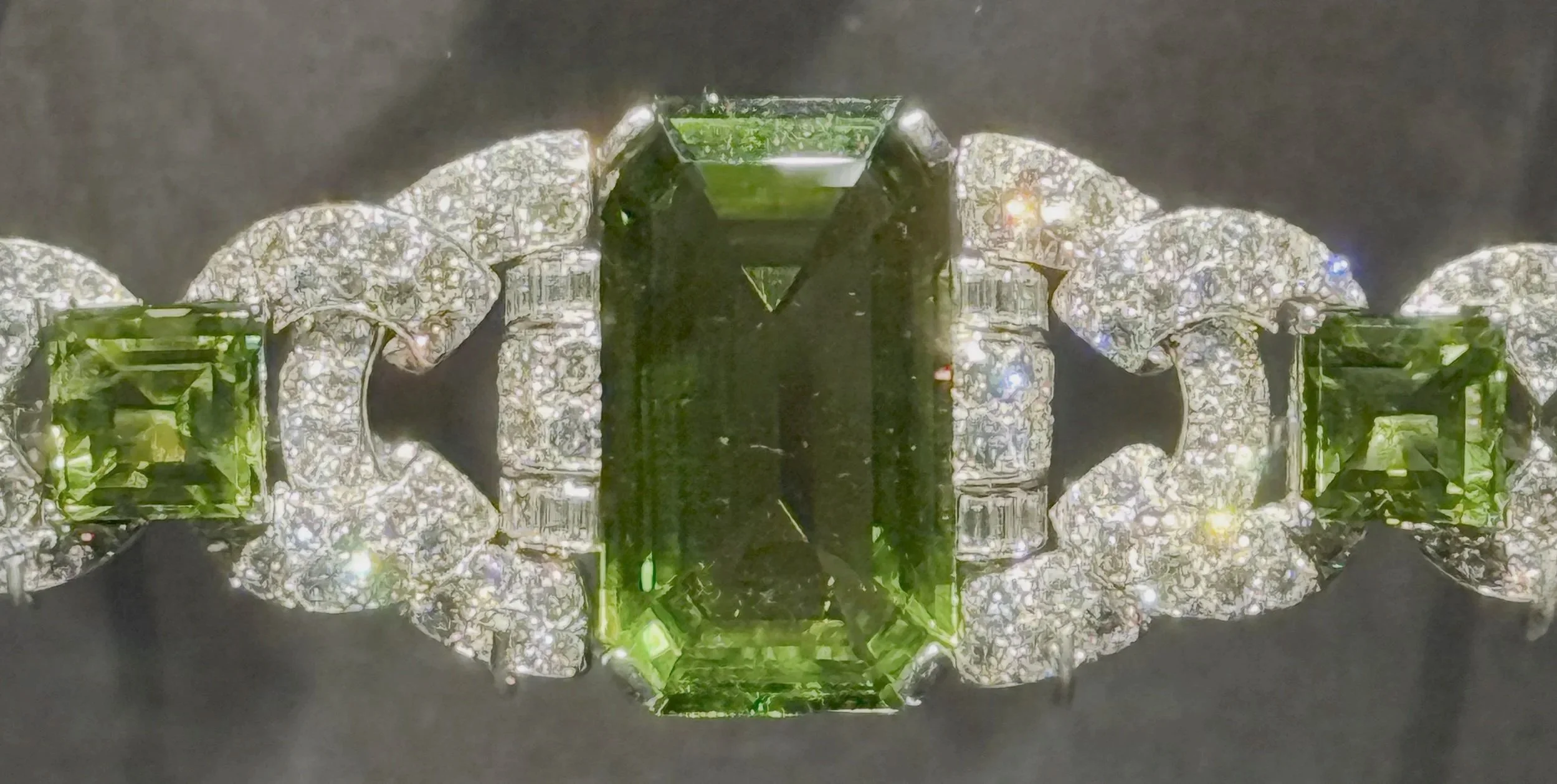
Cartier, Emerald, Diamond and Platinum bracelet
Art Deco jewellery has never really gone away, but there are moments when it comes back into sharp focus. In April 2025 the jewellery press marked 100 years of Art Deco with a retrospective of its most gem-laden pieces, and specialist dealers continue to publish buying guides devoted entirely to work made in the 1920s and 30s. The style has a hold on people because it does something unusual: it is decorative without being fussy, and architectural without being cold.
For anyone buying, inheriting or commissioning a piece in 2026, the practical questions are consistent. What actually makes jewellery Art Deco? Which metals and stones were in fashion in the period? And how do you get the geometry right so a new piece reads as confident design rather than costume?
What Counts as Art Deco Jewellery
The simple and short answer is the 1920s and 1930s.
Dealers who specialise in the era tend to catalogue pieces made between 1920 and 1935, and current buying guides describe collections of rings, bracelets, brooches and earrings drawn from those two decades. The style itself grew out of pre-war French design, which is why so much of the period's output carries a distinctly continental confidence in line and proportion.
The visual signature is easy to recognise once you have seen a few good examples. Think bold geometric elegance, striking silhouette and intricate craftsmanship working together. Where Edwardian jewellery was light and lacy, Art Deco jewellery is structured. Shapes are repeated, lines are clean, and ornament is controlled rather than scattered.
It is also worth separating two things that often get muddled. There is period Art Deco jewellery, made during the 1920s and 30s, and there is Art Deco style, which is a design language anyone can work in today. Both are legitimate, but they are not the same purchase.
The Metals: Platinum, White Gold and the Question of Substitution
White metal is central to the look. Platinum dominates the finest period pieces, and a specialist catalogue will typically describe geometric diamond rings, sapphire brooches and platinum necklaces as the core of an Art Deco collection.
White gold plays an important supporting role. It was invented in the 19th century, but it became a popular white metal in Art Deco jewellery and was regarded as a lower-cost substitute for platinum (an interesting fact is that in modern times platinum is cheaper than gold as a raw material). That history is useful when you are evaluating a historic piece, because the metal tells you something about the budget and the market the jewel was made for. It does not make the piece inferior as a design object, but it should be reflected in what you pay and in how you describe it.
Gold has a place in the story too, particularly for anyone commissioning new work, owing to the price of platinum vs gold. If you want an Art Deco piece in yellow or white gold rather than platinum, the geometry has to carry more of the visual weight, because the metal itself will read warmer and softer than the cool, mirror-bright surfaces of the period's platinum work.
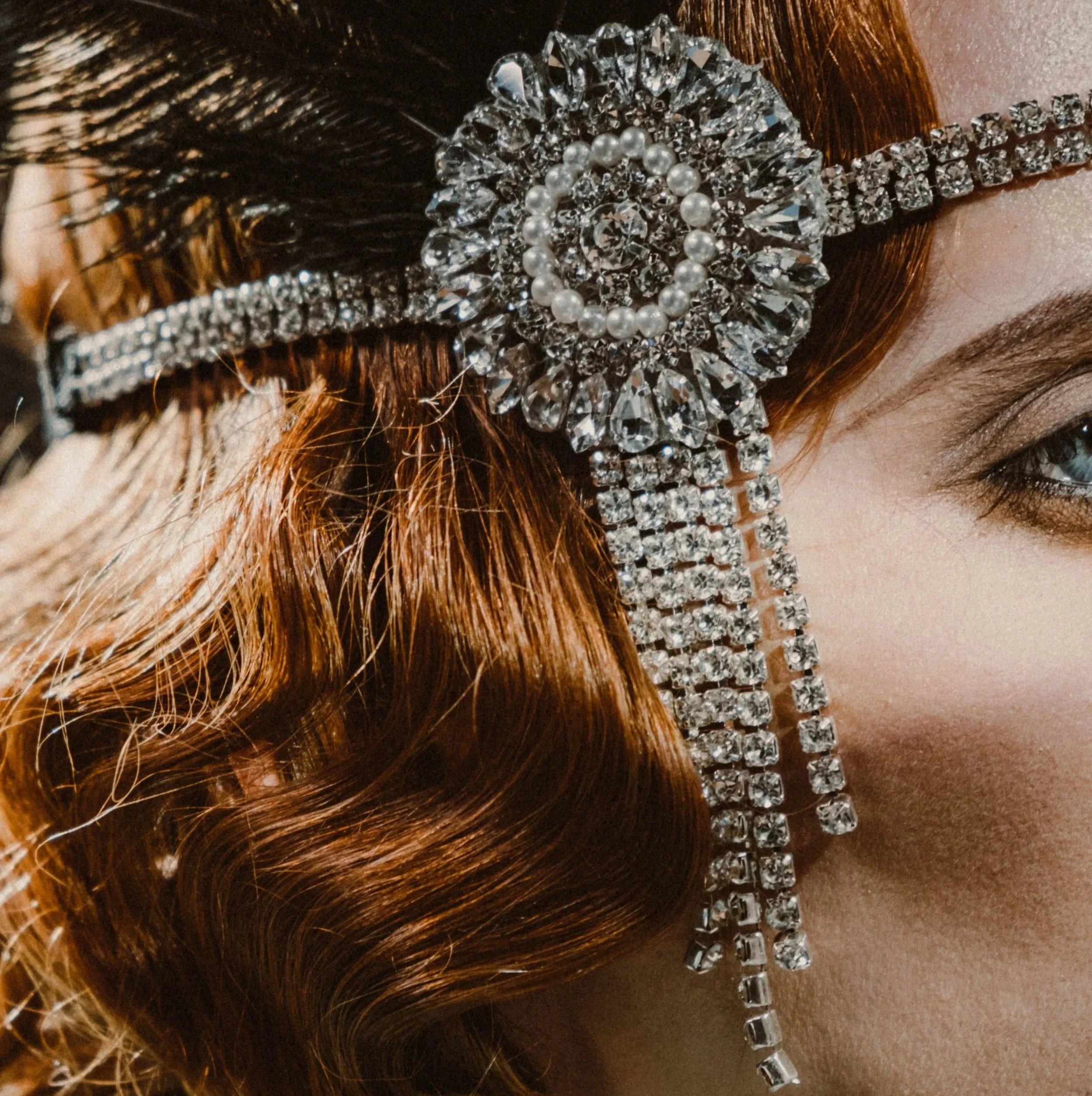
Close-up of an Art Deco headband with diamonds and feathers on red hair. (Cottonbro Studio, Pexel)
The Shapes That Define the Era
Certain forms recur so often that they have become shorthand for the style. A few of the most recognisable:
• Geometric diamond rings, where the stone is set into a composition of steps, angles or repeated motifs rather than a single soft halo.
• Sapphire brooches, often built around strong colour contrast and a graphic outline.
• Platinum necklaces with clean, linear structure, sometimes with a pendant drop.
• Sautoirs, the long chain necklaces associated with the flapper silhouette of the 1920s.
• Dress clips worn in pairs, a form discussed further below.
Notice how much of this relies on restraint. The best Art Deco pieces are not the busiest ones. They pick a shape, commit to it, and let repetition and proportion do the work.
Convertible Jewellery: The Era's Most Practical Trick
Convertible jewellery was a notable feature of pieces from the Art Deco period, and it remains one of the most appealing things about collecting it. The classic example is a double clip: two matching dress clips that can be worn separately on a neckline or a pocket, or joined together to form a larger single ornament.
That flexibility was not an afterthought. It reflects a period in which jewellery was expected to work across different outfits and different times of day. For a modern buyer it is a genuine advantage, because a convertible piece earns its place in a collection far more readily than something that only suits one occasion. When you are assessing a convertible jewel, check that the mechanism still holds firmly and that both halves are present and matching, since a separated pair is much less useful than a complete one.
Period, Inspired or Bespoke: Three Routes Compared
Most people arrive at Art Deco jewellery through one of three doors. The right choice depends on whether you want historical authenticity, a particular silhouette, or a piece built around your own brief.

With period pieces, buy on condition as much as on looks. Ask direct questions about repairs, replacement stones and any resizing, and expect that a specialist dealer will be able to answer them. With modern interpretations, the risk is pastiche: a chevron here and a stepped shoulder there do not automatically make an Art Deco jewel. The proportions have to be resolved, and the settings have to be considered as part of the composition rather than as a holder for a stone.
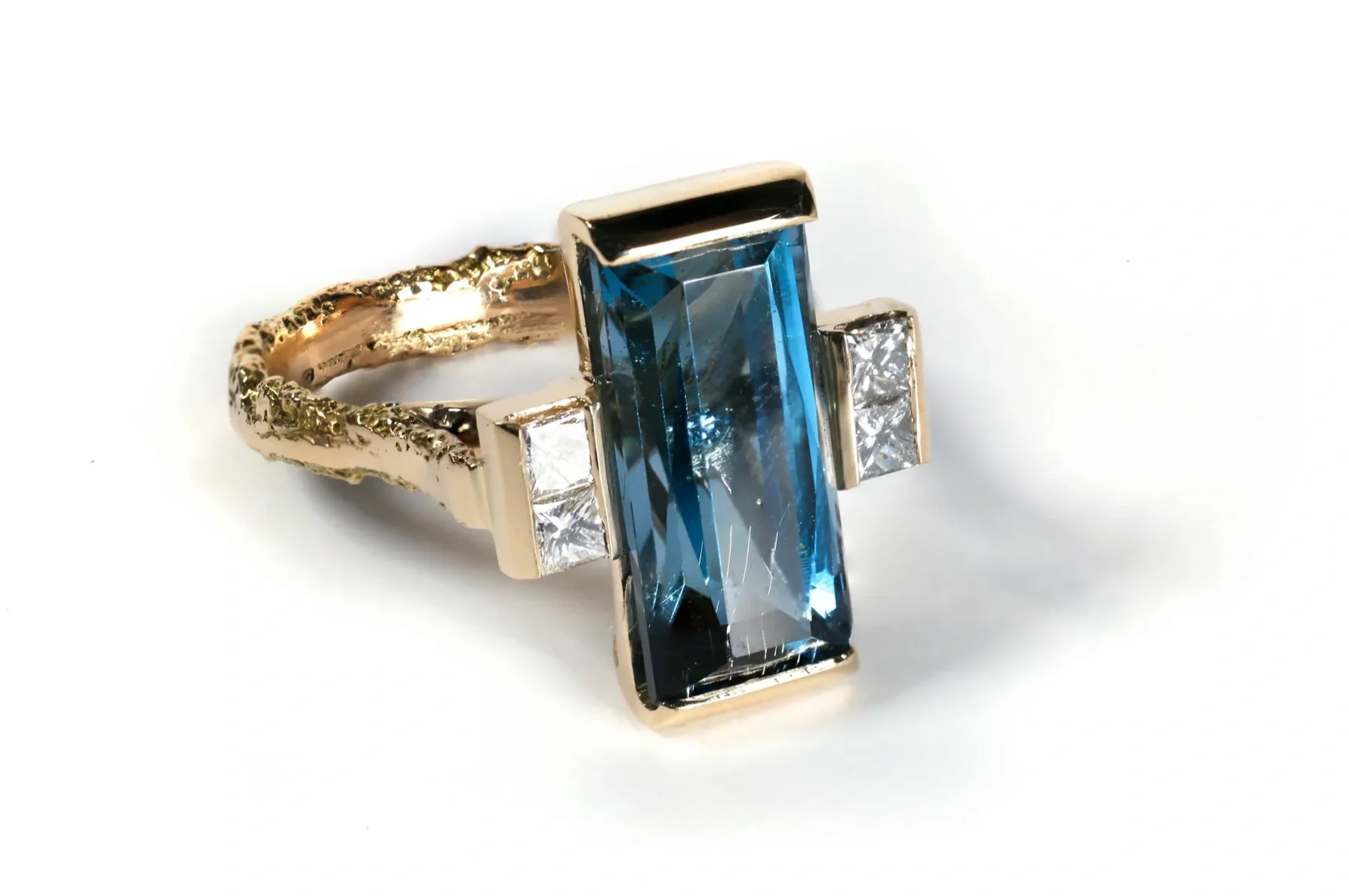
METROPOLIS Ring 4, part of the METROPOLIS Collection, 14ct SMO gold, Ocean Diamonds and 7.5ct precision cut London Blue Topaz
Commissioning a Modern Art Deco Piece
A bespoke commission is where the style becomes personal. In my Cambridge workshop, the METROPOLIS collection sits alongside the ATOMIUM designs, all of the pieces built on the same principle: strong geometry, considered weight, and metal that is meant to be worn rather than admired in a cabinet.
The pieces are made by hand using sandcasting, which gives the metal a surface that is textured, chaotic and tactile rather than perfectly machined. That is a deliberate contrast with the mirror-polished platinum of the 1920s. Cast in ethical Single Mine Origin gold, an Art Deco commission keeps the lines of the period while the material behaves in a way that is entirely contemporary.
Commissions start from £3,000, which covers engagement rings, wedding rings, anniversary pieces and heirloom redesign. If you are bringing an inherited stone or an unworn piece into the process, remelting and redesign are both possible, and it is often the most satisfying route: the geometry gives old material a clear new structure.
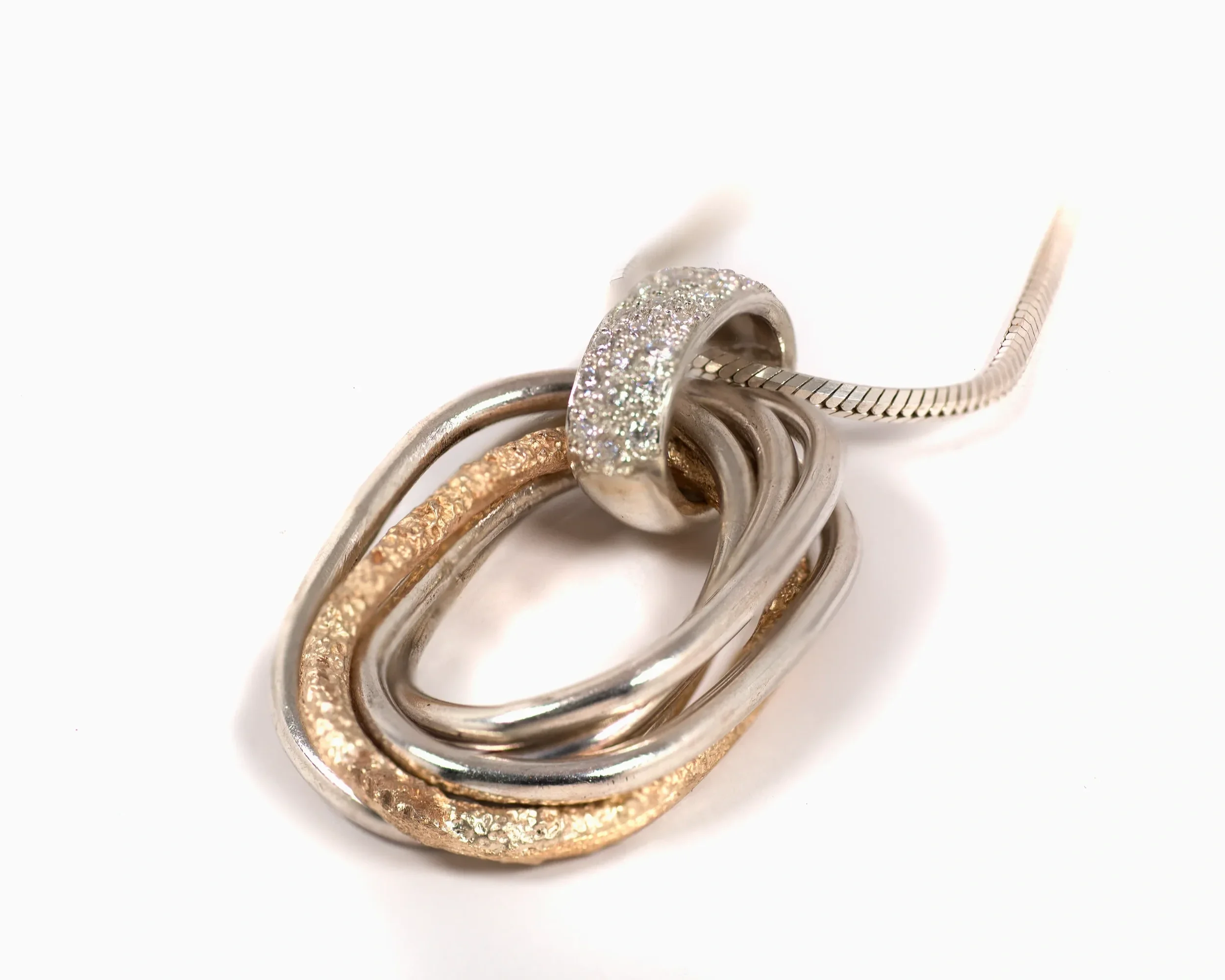
ENTWINE Pendant 2 - SMO Gold, sterling silver and moissanite, part of the ENTWINE collection.
Getting the Details Right
Three things separate a piece that works from one that merely looks the part.
The first is proportion. Art Deco design depends on relationships between widths, gaps and repeats. If the band is too narrow for the head, or the side detail too small to register, the whole composition weakens.
The second is wearability. A jewel with sharp internal angles may catch on clothing, and a tall stepped setting may sit awkwardly under a sleeve. Ask to see a piece from the side as well as the top, and think about how it will feel after a full day.
The third is restraint. It is tempting to add one more line, one more stone, one more step. The period's best work knows when to stop, and a commission should be edited with the same discipline.
Caring for Art Deco Jewellery
Older pieces deserve a gentle approach. Store them separately so that harder stones do not scratch softer metal or neighbouring jewels, and have settings checked periodically, particularly on rings worn daily. Where a piece has older repairs, unusual stones or a convertible mechanism, take advice from a jeweller before cleaning it yourself rather than relying on a general household method.
Frequently Asked Questions
What period counts as Art Deco?
The 1920s and 1930s. Dealers who specialise in the era generally catalogue pieces made between 1920 and 1935, and current buying guides describe collections of rings, bracelets, brooches and earrings from those two decades. The style grew out of pre-war French design, so pieces made slightly either side of that window are sometimes described in similar terms.
Why was white gold used in Art Deco jewellery?
White gold was invented in the 19th century and became a popular white metal during the Art Deco period. It was considered a lower-cost substitute for platinum, which dominated the finest pieces. That does not make white gold work inferior in design terms, but the metal is a useful indicator of the market a jewel was originally made for.
What is convertible Art Deco jewellery?
Convertible jewellery was a notable feature of the period. The best-known example is a double clip: two dress clips that can be worn separately on different parts of a garment, or joined together to form one larger ornament. The idea was flexibility, allowing a single piece to suit more than one outfit or occasion.
Can an Art Deco design be made as a new piece?
Yes. A goldsmith can build a new jewel around period geometry, using hand techniques such as sandcasting in ethical Single Mine Origin gold. This suits people who want the look and structure of the era but prefer new metal, a personal stone choice, or a design adapted to their own hand and everyday wear.
Is Art Deco jewellery a good investment?
That depends on the individual piece rather than the style as a whole. Condition, craftsmanship, provenance and the originality of the stones all affect value, and rarity varies enormously across the period. Treat any purchase as a design decision first, and take specialist advice on valuation and authenticity before spending at a significant level.