Two different colour 14ct Single Mine Origin gold casting grain on a Cambridge goldsmith's bench.
Most fine jewellery begins its story in a workshop: a sketch, a carved wax, a crucible of molten metal. Single Mine Origin (SMO) Gold pushes that story back several thousand miles, to one specific mine, and keeps a paper trail running the whole way from the seam to the ring on your finger.
That distinction sounds small. In practice, it changes what you can know about a piece of jewellery, and what a jeweller can honestly tell you about it.
What Single Mine Origin (SMO) Gold actually means
Single Mine Origin (SMO) Gold is gold that has come from a single, audited gold mine rather than a pooled supply of metal refined from dozens of unknown sources.
A chain of custody is maintained along the entire supply route: from the mine, through refining, through the metal dealer, through the workshop, to the finished piece. SMO states that this chain of custody is documented and audited for every gram of gold. To qualify as an SMO Member Mine, an operation must meet strict environmental, health and safety, and worker-protection benchmarks under international standards of best practice, ensuring the resulting gold is conflict-free.
Because mines are assessed as named operations rather than blended into an anonymous supply, those standards are applied to somewhere real, with a name and a location. That is a meaningfully different thing from a scheme that certifies a refinery's output without visibility further upstream.
Why a single mine is a different claim from "ethical gold"
Plenty of jewellery is sold with reassuring adjectives on the label—traceable, responsible, sustainable. Those words can mean a great deal, or very little, depending on who is using them and whether anything sits behind them.
The SMO Gold claim is narrower and more verifiable. It does not simply say the metal was handled well somewhere along the way; it says the metal came from one named mine assessed against published standards, and that its journey to the finished piece is recorded. For details of the mines that are SMO Member Mines please view the page on their website.
For anyone commissioning an engagement ring, wedding band, or signet meant to last decades, that specificity is worth more than a broad label on a swing tag.
How the documentation works, and how SMO Gold reaches the bench
Because SMO Gold is audited for every gram, the paperwork travels with the metal. On the investment side, SMO-approved gold turned into exchange-traded holdings is refined and delivered into HSBC's vaults with full chain-of-custody documentation—the same audit rigour that applies, at a smaller scale, to the metal arriving at a goldsmith's bench.
Traceability is only useful if the metal can actually be worked. In the UK, the Betts Group supplies SMO Gold, including material sourced from the SABODALA-MASSAWA gold mine in Senegal, alongside partners such as London-listed Endeavour Mining, in the formats a goldsmith needs: billet, sheet, wire, tube, and casting grain. Casting grain is the form that matters most to a sandcaster, since it can be weighed precisely and melted cleanly in a small crucible.
Interest has grown well beyond individual workshops, with SMO bringing together figures from across the gold and jewellery trade at Goldsmiths' Hall around a simple premise: provenance gives gold its story.
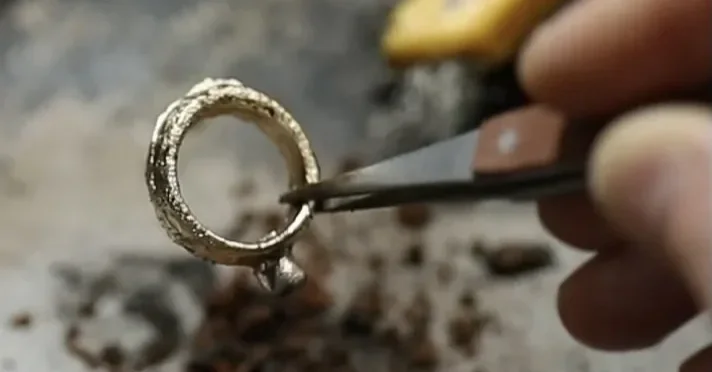
Raw sandcast SMO Gold ring fresh from the mould
What this means for a sandcast commission
In my Cambridge workshop, SMO Gold is my default for newly sourced gold commissions, sitting alongside diver-recovered Ocean Diamonds, traceable coloured gemstones, and circular goldsmithing—where existing heirloom or auction pieces are dismantled by hand and reworked.
My signature approach, Sentimental Topography, casts sand gathered from a beach or landscape that means something to you directly into the surface of the finished metal. A commission from a starting budget of £3,500 might begin with a conversation about a stretch of coastline and end with a band whose surface holds the grain of that coastline in solid gold.
Provenance runs in two directions in a piece like that. One is personal: the sand, the place, the memory. The other is material: a metal that can be traced back to one named mine rather than disappearing into an anonymous pool. Both are forms of knowing where something came from, and both are difficult to fake.
The same thinking applies to heirloom remodelling, heavy-gauge signet rings, and high-palladium 18ct white gold. Metal with a known origin is easier to stand behind when it is being worn daily, reset, or handed on.
(For a full breakdown of how SMO Gold, Ocean Diamonds, and circular goldsmithing work together on a commission, see Provenance & Bespoke Commissions.)
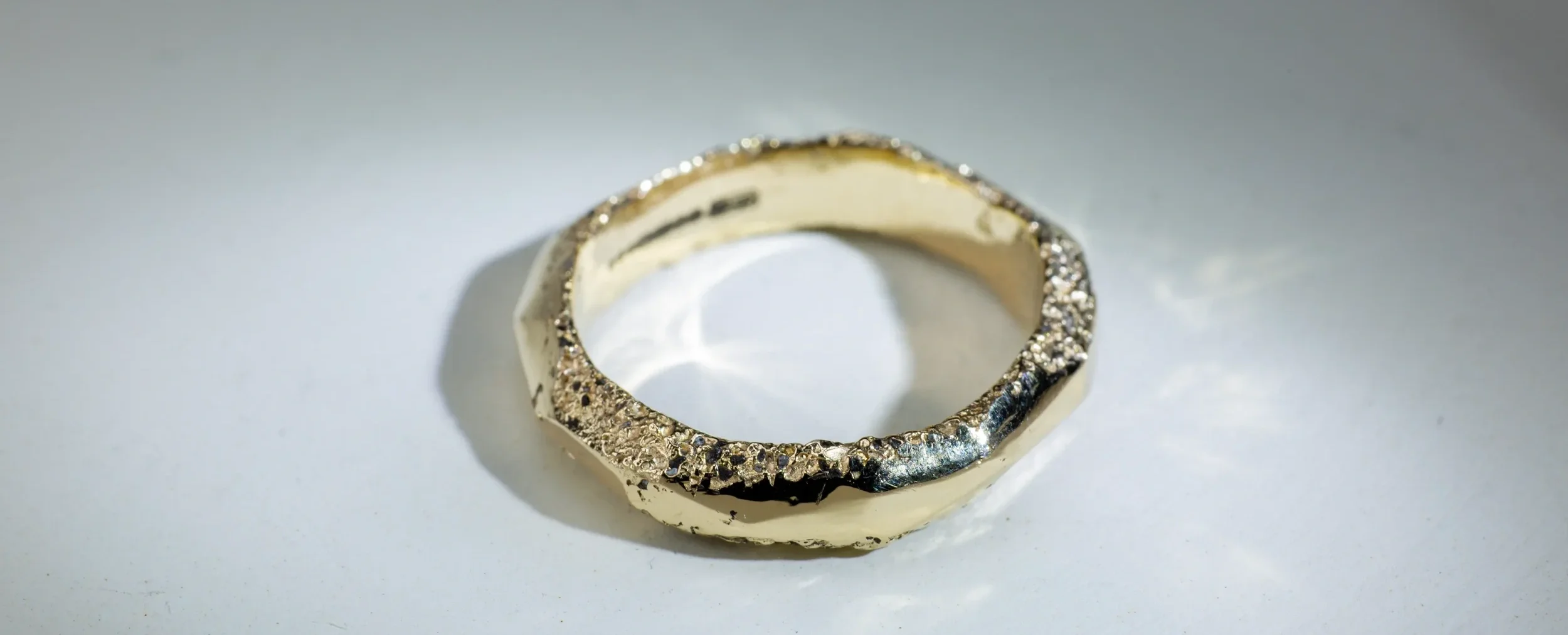
Finished bespoke 14ct SMO Gold ARCANUM sandcast ring with coastal texture and refined geometric faceting.
Questions worth asking any jeweller
If provenance matters to you, ask directly. A jeweller working in SMO Gold should be able to answer without hesitation:
Which mine did the gold in this piece come from?
Is the piece made from SMO-certified gold, and can I see that confirmed?
What documentation accompanies the metal from mine to finished product?
Where were the gemstones sourced, and what do you know about them?
Which parts of the making were done in the UK, and by whom?
Anyone who cannot answer the first question is not working in Single Mine Origin Gold, whatever the marketing suggests.
What SMO Gold does not claim
It is worth being precise about the limits. SMO certification speaks to the origin and custody of the gold, and to the standards the originating mine has met. It is not a statement about every material in a piece, which is why diver-recovered Ocean Diamonds and traceable coloured gemstones are documented separately, and it is not a substitute for sound workshop practice, structural integrity, or a piece engineered to survive daily wear.
It also does not dictate what a piece should cost. Pricing depends on the weight of metal, the complexity of the making, and the stones involved. Ask for a clear breakdown rather than assuming a certification carries a fixed premium. If a specific environmental or sourcing standard matters to your decision, verify it with your jeweller and with Single Mine Origin directly before you commission.
Why it matters for a ring you plan to keep
An engagement ring, wedding band, or self-commissioned signet is one of the few objects you might wear every day for forty or more years. Where the metal came from is part of its story, and until recently it was a part almost nobody could tell you.
SMO Gold makes that part answerable: one mine, one documented route, one named operation held to published standards. Add sand from a beach that matters to you, cast into the surface by hand in a Cambridge workshop, and the object carries two kinds of provenance at once—the place the gold came from, and the place you did.
Frequently Asked Questions
Is Single Mine Origin Gold the same as recycled gold? No. Recycled bullion is existing metal returned to the industrial supply; whilst it avoids new mining, it is typically pooled from mixed, anonymous sources. SMO Gold is newly mined metal from one named, audited mine with a documented chain of custody. In my workshop, if you want to avoid new mining without losing provenance, I also offer circular goldsmithing—hand-dismantling a known family heirloom or whole auction piece so its history stays intact. (For a deeper comparison of recycled bullion, Fairmined, SMO Gold, and Ocean Diamonds, read A Guide to Provenance in Bespoke Jewellery.)
What is an SMO Member Mine? A Member Mine is an operation approved by Single Mine Origin after assessment against international environmental, health and safety, and worker-protection standards. Gold from a Member Mine is kept segregated through refining and supply, with the chain of custody documented and audited for every gram.
Can I commission a bespoke ring in SMO Gold? Yes. Bespoke sandcast engagement rings, wedding bands, and signets are crafted in SMO Gold as default for newly sourced metal, with commissions guided from a starting budget of £3,500. All pieces are made in the UK, hallmarked at the Edinburgh Assay Office, and consultations can be held in person or virtually across the UK.
How do I know a jeweller is genuinely using SMO Gold? Ask which mine the gold came from and what documentation accompanies it. A jeweller working in SMO Gold should be able to answer both directly; if the conversation stays at the level of vague marketing language, treat the claim with caution until it is confirmed.
If you are considering a bespoke commission in SMO Gold—or want to discuss pairing it with diver-recovered Ocean Diamonds or heirloom gold—explore Provenance & Bespoke Commissions or get in touch to arrange a relaxed consultation.