A ring can hold a place. Not as a picture or a laser engraving, but as a physical record of a specific stretch of coast, taken from the sand itself and transferred into solid gold. A landscape cast gold ring is made by using beach sand as the interior surface of the mould, so the molten metal takes on the exact grain, ripples and ridges of the shoreline it came from. The result reads like terrain in miniature—tactile and uneven, with the low relief of coastal dunes or a mountain ridge running around the band.
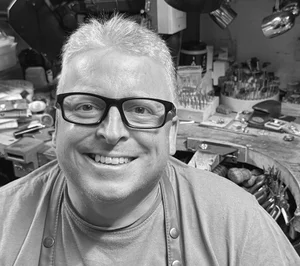
I craft these pieces at my Cambridgeshire bench as part of my Sentimental Topography work, and the metallurgical discipline is the same whether the sand comes from a Cornish cove, a Scottish bay or a riverbank a client walked as a child. Here is how the casting works, how to collect a sample that will survive the crucible, and which design decisions genuinely change the finished ring.
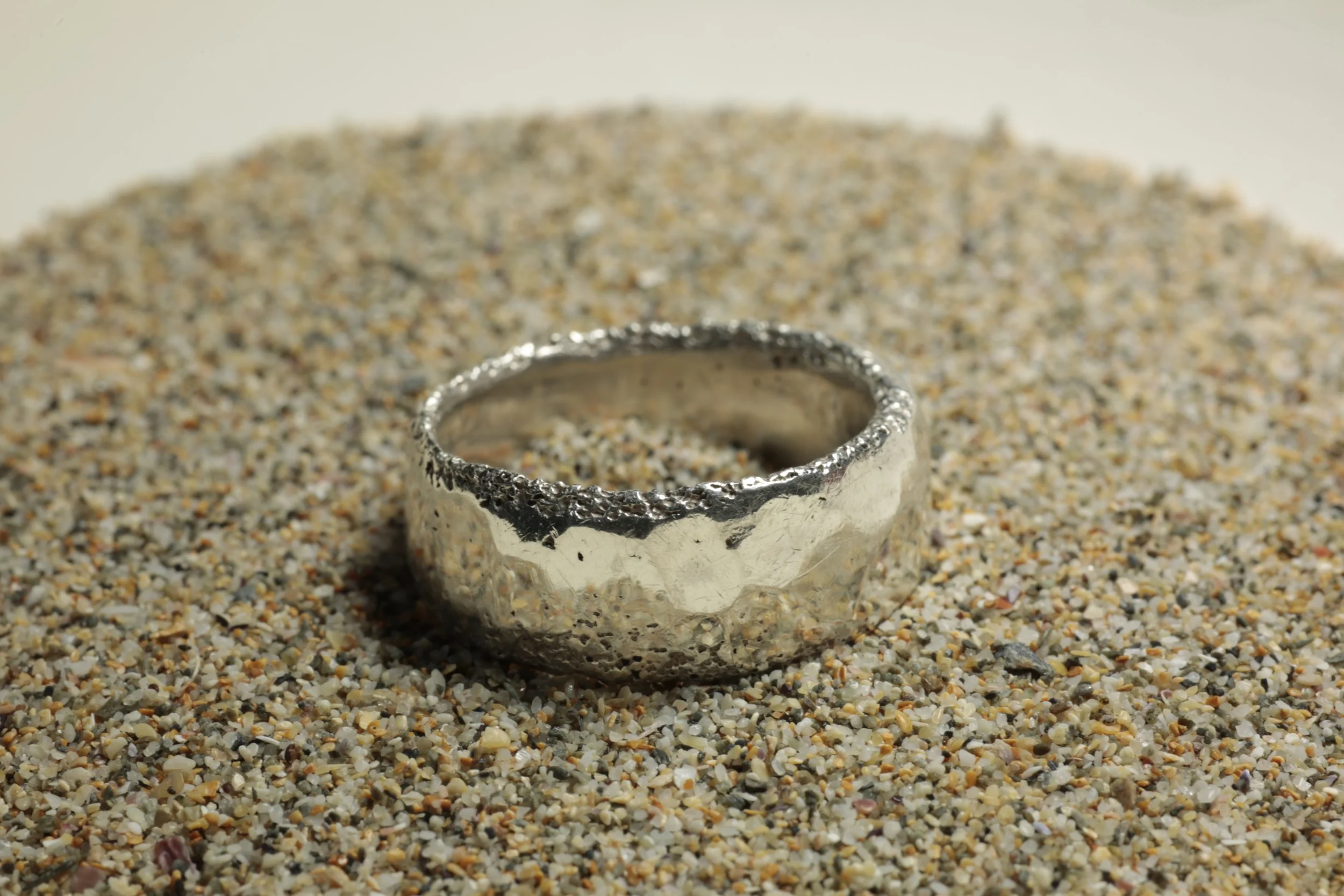
Sentimental topography 14ct white gold ring resting on Chapel Porth coastal beach sand in my Cambridge studio
What a Landscape Cast Gold Ring Actually Is
The phrase covers several approaches, so precision matters. In every commission, the ring is cast directly into sand—never machine-milled or stamped with a pattern afterwards. A common starting scale is a heavy-gauge band of roughly 5mm in width, which gives enough architectural surface for the coastal terrain to read clearly without feeling unwieldy on the hand. Pieces of this kind can be forged in recycled 14ct and 18ct gold or sterling silver.
What separates a true landscape cast ring from a generic textured band is verifiable provenance. The sand is not an anonymous foundry texture bought from a trade catalogue. It is a specific sample with coordinates and a memory attached—and the person wearing the ring knows exactly which tide line it came from. That is the difference between surface ornament and a wearable archive.
Why the Sand Is the Mould, Not a Decoration
In sandcasting, sand is packed firmly around a pattern inside a two-part metal flask. When the pattern is withdrawn, it leaves behind a negative cavity whose walls carry every grain and hollow of that particular shoreline. Molten gold is poured directly into the void, and as it cools, the metal locks in the physical impression of the beach rather than an artist's interpretation of it.
This is why the surface of a sandcast ring looks genuinely geological. Subtle ridges form where grains were compressed more tightly, hollows appear where coarser particles sat, and the edges retain a soft, water-worn quality that no file or bur can convincingly replicate. Every casting is strictly one-of-a-kind, because the mould is packed by hand and broken apart to release the gold. While some jewellers cast into plaster investment around a carved wax model, producing a sharper, more uniform finish, real sand remains the most honest medium for recording a shoreline.
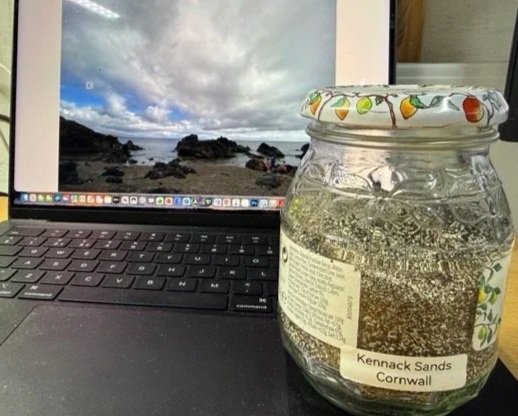
Labelled glass jar of Kennack Sands beach sand (and an image of the beach in the background) used for a bespoke Sentimental Topography gold ring commission
Collecting a Shoreline That Will Survive the Crucible
The sand you send matters, and different coastlines behave very differently under the heat of a casting torch. A few practical guidelines make the difference between a crisp impression and a failed pour:
Collect dry sand from above the high-tide line where possible (always checking local signage to ensure small-scale collection is permitted on that stretch of coast). Damp sand or material heavy with salt and organic matter must be thoroughly dried before it goes anywhere near a flask.
Avoid sand thick with seaweed, driftwood or large shell fragments. Crushed shell grit usually casts cleanly, but bulky organic debris burns unevenly under molten gold and leaves voids in the band.
Gather more than you think you need (e.g. half a jam jar). A two-part casting flask takes a surprising volume of sand, and running a test mould should never require a second trip to the coast.
Store the sample in a sealed, labelled jar with the exact beach name and collection date written on it. Those details become part of your commission record for decades to come.
Take a photograph of the spot. Because I cannot walk every shoreline with you, seeing whether the sand came from a sheltered dune or an exposed storm beach helps me interpret how the relief should sit across the ring.
Very fine estuarine silt casts quite differently from coarse Cornish granite sand, so I always run a small diagnostic test on my bench before committing gold to the final mould.
From Beach to Bench: The Casting Sequence
The studio sequence is deliberate, with each stage calibrated for daily permanence:
Architectural Proportioning: We begin by establishing the band width, wall thickness, comfort-fit interior curve and, if desired, plans for flush-set, grain-set or collet-set gemstones. A 5mm width is an ideal benchmark for reading landscape detail clearly.
Packing the Two-Part Flask: A bespoke pattern is sized to your finger and a mould is formed in the flask using your dried shoreline sand, rammed in thin, even layers so the grains lock together without trapping air.
Pattern Withdrawal & Venting: The flask halves are separated, the pattern is lifted out cleanly to preserve the sand impression, and fine vents are cut to allow displaced gas to escape during the pour.
Melting & Pouring: I melt 18ct Single Mine Origin (SMO) gold (or your chosen precious metal) in a crucible and pour it in one steady motion into the sand cavity.
Breakout & Conservative Finishing: Once cooled, the sand mould is broken away, the casting sprue is removed, and the metal is pickled clean. Finishing is intentionally restrained: I polish the interior to a smooth comfort fit and often polish the outer too (for wearer comfort), leaving the rims of cast coastal skin untouched so heavy polishing never erases the terrain.
Design Choices That Shape the Landscape
Two rings cast from the exact same jar of sand can look markedly different, because subtle bench decisions govern how much terrain is visible and how the ring wears over decades:
Band Width: A narrow 3mm band captures a delicate sliver of coast. Around 5mm, the grain reads clearly as miniature terrain; wider 7mm+ bands become bold architectural monoliths.
Metal & Carat: 18ct SMO yellow gold brings rich warmth to raw texture; 14ct SMO gold offers a paler champagne tone and added hardness for grain-setting stones; sterling silver gives a cool, high-contrast shadow in the crevices.
Interior Profile: A softly domed comfort-fit interior ensures a substantial, heavy-gauge textured band slides easily over the knuckle and feels effortless all day.
Surface Finish: Leaving the raw cast skin intact preserves fine mineral grain. Lightly burnishing the high points creates bright highlights against dark, matte hollows.
Sand Character: Coarse coastal sand creates bold ridges and deep relief; fine wind-blown dune sand yields a subtle, almost frosted mineral surface.
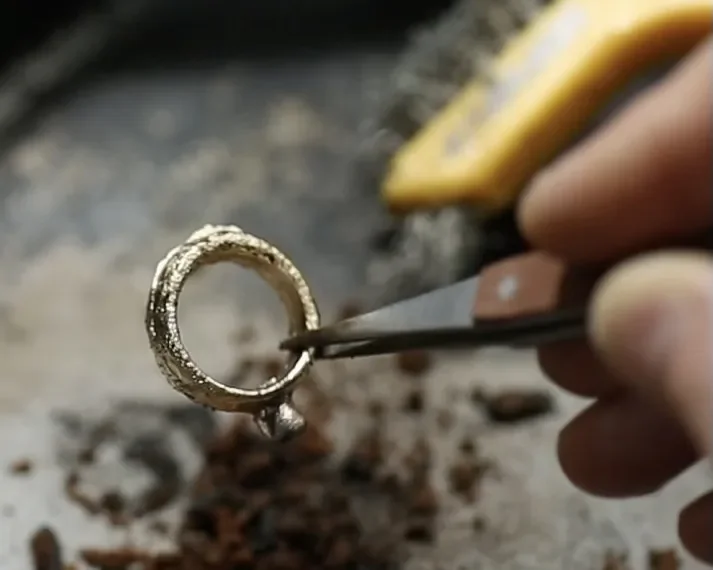
Close-up of raw coastal sand texture cast into solid gold on goldsmith Iain Sainsbury's bench
Gold That Carries Its Own Provenance
A ring that records a meaningful shoreline invites an obvious question about where the metal itself came from. For landscape cast commissions, I work primarily in Single Mine Origin (SMO) gold, which is fully segregated and traceable back to a single responsible mining operation rather than relying on opaque, unverified recycled claims.
Where clients wish to incorporate family history, I can also test and remodel inherited heirloom gold—blending it with new SMO gold where needed so the finished band carries both personal ancestry and traceable provenance.
If you would like gemstones nestled into the coastal ridges—similar to the hand grain-set pieces in The ARCANUM Collection, seabed-collected Ocean Diamonds offer a natural marine provenance that pairs seamlessly with a coastal commission.
Every piece is independently hallmarked at the Edinburgh Assay Office (and my Assay Assured accreditation).
Commissioning One: Practical Details & Next Steps
Most of the critical decisions happen before any gold is melted. A helpful initial brief includes a small jar/packet of dry sand, the location and date it was gathered, your ring size, and an idea of preferred band width and metal. (If you are commissioning from elsewhere in the UK or abroad, I can advise on rings sizing or send an insured sizing and sample kit directly to your door following a virtual consultation.)
Because every sand mould is destroyed to release the casting, no two pours ever repeat—and your finished ring will always differ slightly in micro-detail from any initial sketch. That collaboration with raw geology is the entire point. At my Cambridge studio, bespoke landscape cast rings start from £3,500 in 18ct SMO gold (and from £1,500 in silver), with a typical lead time of 6 to 10 weeks from design approval to UK hallmarking.
Living with a Textured Landscape Ring
A sandcast gold surface evolves gracefully with wear. Over years of daily life, the highest ridges gently burnish against skin and fabric while the deeper coastal hollows retain their crisp mineral definition—meaning the ring ages in step with its wearer.
Care is straightforward: soak the ring in warm water with a drop of mild washing-up liquid, brush gently with a soft toothbrush to clear everyday dust from the grain, rinse, and pat dry with a soft lint-free cloth. Store it separately from diamond jewellery so harder stones do not abrade the textured gold edges.
Frequently Asked Questions
Can I use sand from any beach?
Most coastal, riverbed and mountain sands can be cast, though results vary by mineral composition. Dry sand gathered from above the high-tide line works best, whereas sand heavy with seaweed, large shell fragments or damp organic matter must be dried and sieved first. Send a slightly larger jar than you think is needed so I can run a test mould on my bench before pouring gold.
Will every landscape cast gold ring be different?
Yes. Because each two-part flask is packed by hand and broken apart after the pour, the individual sand grains never align the same way twice. Even when two wedding bands are cast from the exact same jar of beach sand, they read as closely related siblings rather than mechanical duplicates.
Can the ring be made in silver or a different carat of gold?
Yes. I craft landscape cast rings in 18ct and 14ct Single Mine Origin gold, and recycled sterling silver. Higher-carat 18ct gold offers rich colour and traditional weight, 14ct gold provides extra hardness where small gemstones are grain-set into the texture, and silver offers a crisp, cool architectural tone at a lower entry investment.
I do not cast in 950 platinum as he melting point of platinum is too close or above that of most sands.
Does the texture wear smooth over time?
It softens gently rather than disappearing. Over decades of daily wear, the highest peaks of the cast grain take on a soft, natural sheen while the deeper hollows hold their rugged contour. Leaving the cast skin unpolished on the exterior and wearing the ring separately from harder stones preserves the landscape detail for generations.
How much gold does a landscape cast ring require?
Metal weight is determined by your finger size, band width, wall thickness and comfort-fit profile rather than the surface texture itself. Once we agree on the architectural proportions during your consultation, I calculate the exact gram weight and provide a fixed written quotation before any gold is melted.