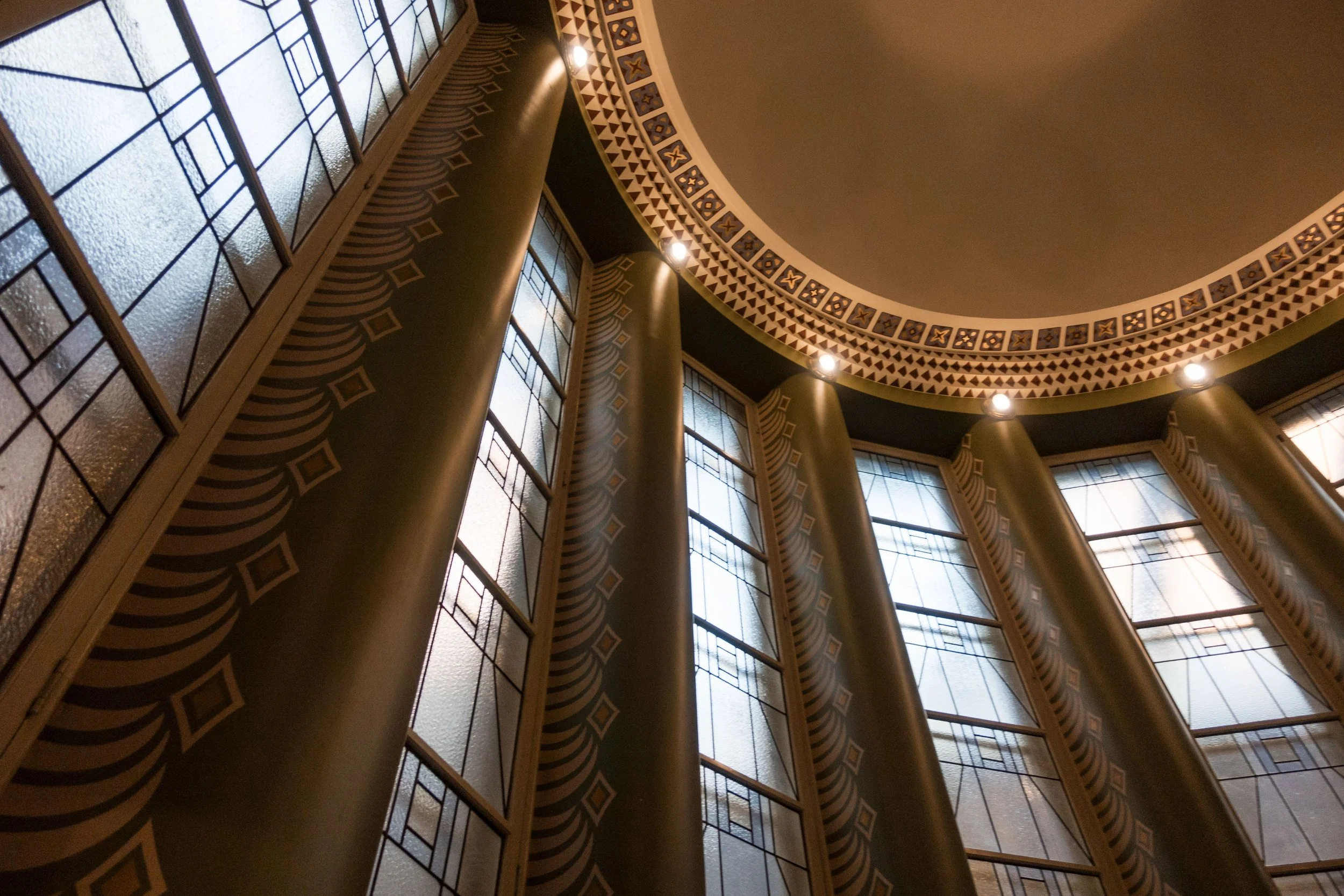
Stunning Art Deco architectural interior with decorative pillars and stained glass in Lahti, Finland. (Photo by Hert Niks on Pexels)
Art Deco design is the visual language of symmetry, shine and momentum. It took hold in the 1920s and 1930s and, a century later, its geometry still surfaces in interiors, architecture, typography and fine jewellery. The name itself is younger than the style. The term, “Art Deco” was coined in the 1960s, long after most of the buildings, posters and objects it describes had been created. That late naming helps explain why the movement can feel vague and all encompassing. It was never a single school with a manifesto, but a broad current that drew on many sources at once.
What Is Art Deco Design?
Art Deco is a style of visual arts, architecture and product design that became popular in the 1920s and 1930s as a response to the rapid modernisation of society. It represented luxury, glamour, exuberance and faith in social and technological progress. As the Victoria and Albert Museum puts it, “…Art Deco is arguably not one style at all, but a pastiche of different styles, sources and influences….”. That is why two Art Deco objects, a lacquered cocktail cabinet and a stepped stone facade, can look quite unlike each other while still reading as part of the same family.
Where Art Deco Came From
Art Deco designers borrowed widely. Their reference points included historic European movements, contemporary avant garde art, the Russian ballets, folk art, exotic and ancient cultures, and the urban imagery of the machine age. This borrowing was not timid. Motifs were abstracted, repeated and recombined until they became something closer to a rhythm than a picture.
One of Art Deco's key sources was its forerunner, Art Nouveau, the fin de siècle style that fell out of fashion in the years before the First World War. Art Nouveau's plant and floral forms gave the newer movement a vocabulary of ornament, but Art Deco pushed that ornament towards geometry, control and repetition.
Art Nouveau and Art Deco Side by Side

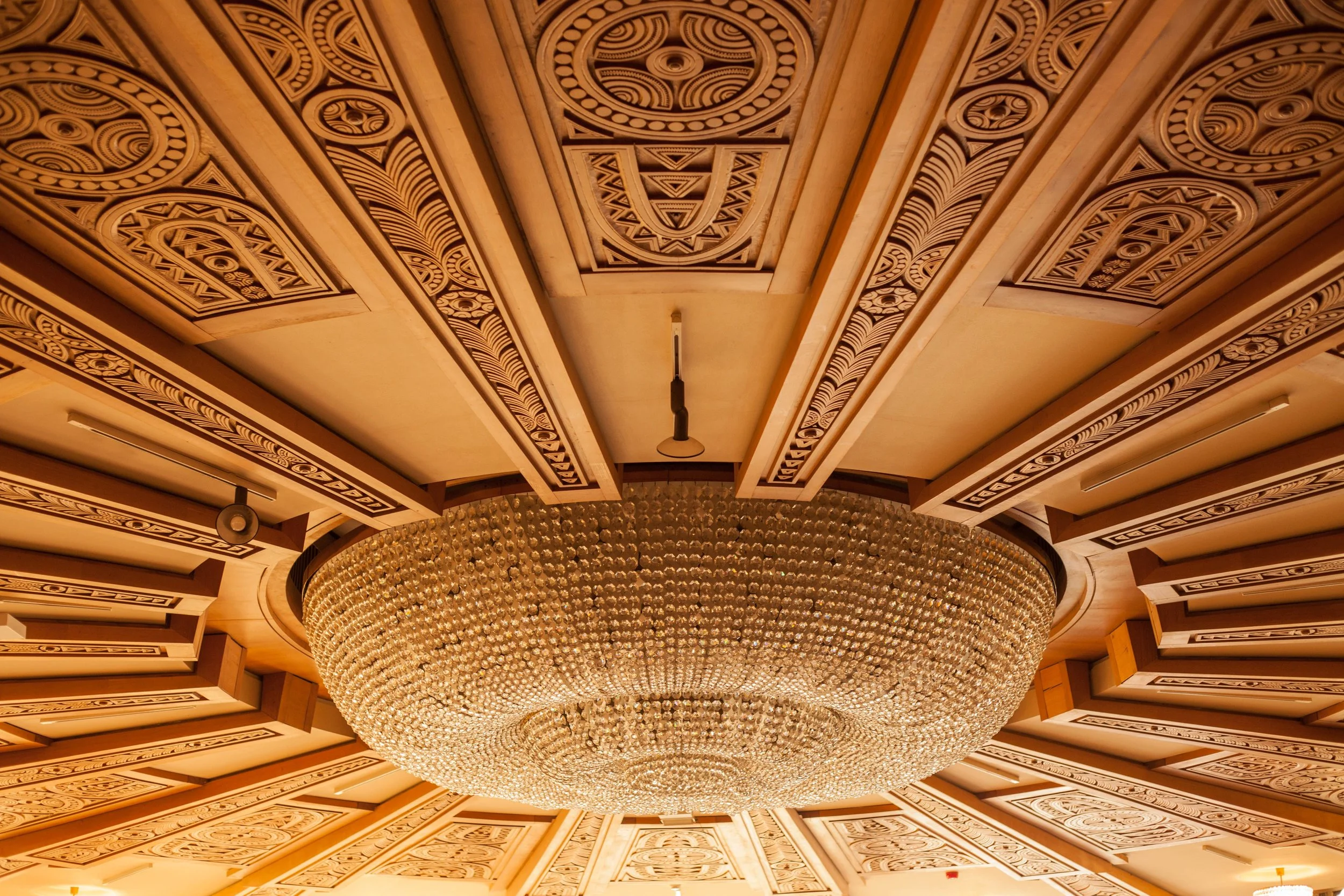
Intricate ceiling design with a stunning crystal chandelier in Sofia, Bulgaria. (Rainer Eck on pexel)
The Defining Characteristics of Art Deco Design
Art Deco is characterised by bold geometric shapes, clean lines and strong symmetry. Repeating patterns such as zigzags and chevrons appear again and again, often within layered compositions that reward a second look. In interiors, the style is frequently described as opulent and decadent, built on geometric patterns and motifs, bold jewel tones and rich material palettes.
Commonly cited characteristics of the style include:
Symmetrical patterns, which give a composition balance and a sense of order
Geometric shapes, from stepped forms to circles, arcs and triangles
Use of layers, so that ornament sits at several depths within a single design
Clean, straight lines that keep detail controlled rather than fussy
Striking colours, often jewel tones set against dark or metallic grounds
Why Art Deco Looked to Machines and Modern Life
The movement was inspired by industrialisation and technical progress, and it incorporated bold geometrical patterns in symmetrical arrangements. Its popularity grew as a response to the rapid modernisation of society, reflecting an era when innovation was reshaping how people lived, travelled and built. There is optimism in that outlook: a belief that new materials and new methods could produce beauty as readily as they produced speed.
That faith in progress is central to understanding the style. Art Deco does not mourn the machine age; it celebrates it, then dresses it in luxury. Transport, electricity, skyscrapers and mass production all fed into a visual vocabulary that felt both modern and magnificent.
Art Deco in Architecture and Interiors
Art Deco is a twentieth century architectural and art style, and it is a design style of the 1920s and 1930s in furniture, decorative arts and architecture, characterised by its geometric character. In buildings, that geometry often appears as stepped massing, vertical emphasis and patterned stonework or metalwork. Skyscrapers of the period are among the most recognisable examples, with the Chrysler Building frequently cited as a landmark of the style.
Inside, the mood shifts towards richness. Interiors lean on bold jewel tones, polished surfaces, mirrored detail and strong material contrasts. Symmetry organises the room, while layered pattern gives walls, floors and furniture a shared rhythm. The result can be theatrical, but it is rarely chaotic, because the geometry holds everything in place.
Art Deco in Jewellery and Metalwork
Because Art Deco reached into decorative arts and product design as well as architecture, its influence travels easily into small objects. In jewellery, the style's habits translate neatly: symmetry, stepped profiles, chevron and fan motifs, and a preference for clean lines over fussy detail. Metal becomes architecture at the scale of the hand.
At Iain Sainsbury Bespoke Jewellery, the Cambridge countryside based independent goldsmith, Art Deco one of the core themes in the METROPOLIS Collection, sitting alongside other named collections ATOMIUM and ENTWINE. The studio's work is primarily focused on the elemental tension between sandcast textures and architechtural form. Most pieces are made from Single Mine Origin ethical gold, and its signature Sentimental Topography technique casts a client's own sand, from a meaningful location, into gold. Commissions start from £3,000, and Iain Sainsbury is a NAJ 2025 Awards Finalist.
An Art Deco brief fits that approach well, because the style rewards proportion and restraint as much as ornament.

METROPOLIS RING 1 - 9ct SMO gold, Brazillian Tourmaline and white sapphires
Art Deco Design in 2026
Some argue the era of Art Deco interior design is over, yet its spirit lives on. As interior designer Jennifer Durand told Architectural Digest, the term generally brings to mind the style and aesthetic most popular during the 1920s and 1930s. Writing in March 2026, Architectural Digest described the interior style as opulent and decadent, defined by geometric patterns and motifs, bold jewel tones and rich material palettes.
That combination explains the continued appeal. In a period of restrained, neutral interiors, Art Deco offers contrast without clutter: one confident geometric gesture, one saturated colour, one polished surface.
How to Use Art Deco Ideas in Your Own Work
The style is easier to apply than to imitate wholesale. A few practical moves carry most of the effect:
Start with symmetry. Place a focal point and mirror the composition around it before adding anything else.
Choose one repeating motif, such as a chevron, fan or stepped line, and use it consistently rather than mixing several.
Build in layers. Set a fine pattern against a larger one so the eye has depth to travel through.
Limit the palette. Bold jewel tones work hardest when they have a dark or metallic ground to sit against.
Let materials carry the glamour. Polished, rich surfaces do more for the mood than added decoration.
Whether you are designing a room, a piece of graphic work or a commission, the underlying discipline stays the same. Art Deco is not simply decoration applied to a surface; it is a way of organising space, proportion and colour so that a design feels deliberate from every angle. That is why the movement continues to shape new work in 2026, and why it remains such a productive starting point for anything made by hand.
Frequently Asked Questions
What defines Art Deco design?
Art Deco is defined by bold geometric shapes, clean lines and strong symmetry, often combined with repeating patterns such as zigzags and chevrons. It is a style of visual arts, architecture and product design that became popular in the 1920s and 1930s, and it represented luxury, glamour, exuberance and faith in social and technological progress. It drew on many sources rather than following a single rulebook.
What are the key features of Art Deco?
Commonly cited features include symmetrical patterns, geometric shapes, use of layers, clean straight lines and striking colours. Interiors in the style are often described as opulent and decadent, built on geometric motifs, bold jewel tones and rich material palettes. Repeating devices such as chevrons and stepped forms tie these features together across architecture, furniture, graphics and jewellery.
What is the difference between Art Deco and Art Nouveau?
Art Nouveau came first. It was the fin de siècle style that fell out of fashion in the years before the First World War, and its visual language leaned on plant and floral forms. Art Deco borrowed from it, along with many other influences, but replaced organic curves with bold geometric shapes, clean lines and strong symmetry, giving the newer style a machine age character.
Why is Art Deco associated with luxury and glamour?
The style emerged alongside rapid modernisation and celebrated it, pairing technical progress with opulent materials and confident colour. Art Deco represented luxury, glamour, exuberance and faith in social and technological progress, and its interiors are still described as opulent and decadent. That mix of optimism and richness is what gives the movement its enduring sense of occasion.
Is Art Deco still relevant in 2026?
Its spirit lives on, even if the original 1920s and 1930s era has passed. Architectural Digest described Art Deco interiors in March 2026 as opulent and decadent, defined by geometric patterns, bold jewel tones and rich material palettes. Contemporary makers use its principles of symmetry, layering and controlled colour rather than reproducing period detail exactly.