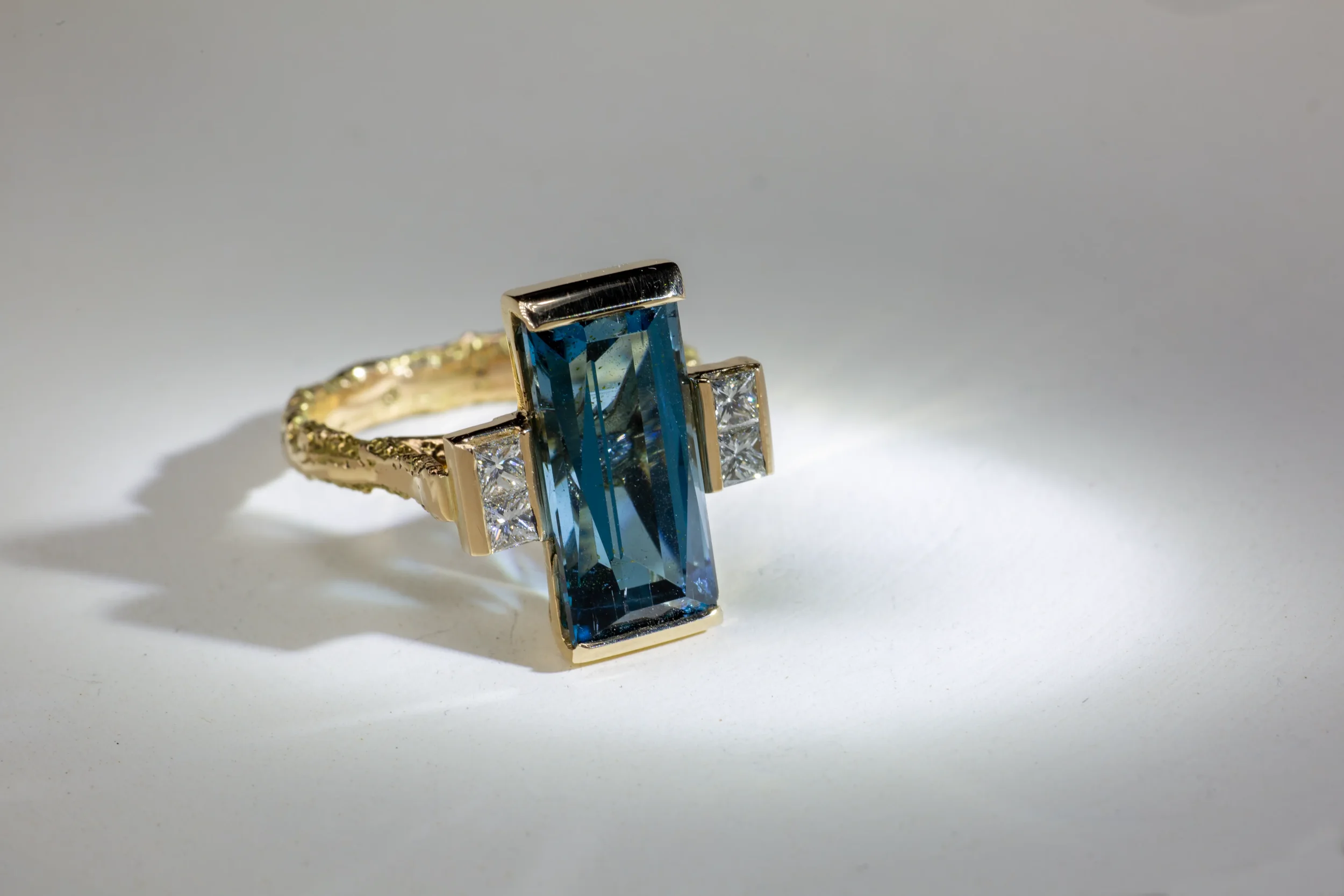
METROPOLIS RING 5 - A 14ct SMO Gold sandcast ring set with diver-recovered princess-cut Ocean Diamonds by Cambridge goldsmith Iain Sainsbury PhD.
A bespoke ring is a small object with a long supply chain behind it. By the time a band sits on a finger, the metal may have passed from the mine through a refiner, an alloyer, and a workshop, and any gemstones through several more hands still. Provenance is the paper trail that makes that journey legible—and in a one-off commission, it is the difference between a reassuring story and a verifiable record.
This guide sets out the routes to traceable, responsibly sourced gold actually available to buyers, the documentation that separates a verified origin from a vague claim, and how diver-recovered Ocean Diamonds fit into the picture. It is written for people commissioning an individual piece rather than buying from retail stock, because that is where traceability becomes both simpler and more personal.
What provenance means in a one-off commission
Provenance is not an aesthetic or a marketing mood; it is documentation, a named source, a refiner, a batch or order reference, and an invoice that matches the metal in your piece. A finished ring has four separate supply chains running through it, and each should be checked on its own:
The metal: Where the gold was mined or recovered, and who refined it.
The alloy: What the pure gold was mixed with to reach 18ct or 14ct, and where that alloying took place.
The workshop: Who cast, forged, set, and finished the piece.
The stones: Where each diamond or coloured gemstone was recovered, cut, and handled before reaching the bench.
The workshop end is straightforward when you work directly with an independent goldsmith making in a single studio.The raw-material end is where language often loosens, which is why the sourcing route matters far more than broad adjectives.
Three routes to traceable gold
Most responsibly sourced bullion falls into one of three distinct categories. They are not interchangeable, and each answers a different question.
Recycled gold
Recycled gold keeps existing precious metal in circulation rather than calling for new extraction. What it establishes is that demand for newly mined gold has been reduced; what it cannot tell you is where the original metal came from,because recycled bullion is pooled from multiple scrap and refining streams before being re-alloyed. It answers a question about demand rather than geographic origin. If you choose recycled gold, ask what proportion of your alloy is recycled and where the refining happened.
Fairmined certified gold
Fairmined certification is applied to gold from certified artisanal and small-scale mining organisations that meet strict standards for environmental protection, safe working conditions, and fair community pricing. For buyers who want an audited social and environmental standard attached to a named artisanal source, it is one of the clearest routes available. Because certification attaches to the bullion rather than the finished ring, ask to see the certificate reference covering the metal ordered for your piece and check that the weight aligns with your commission.
SMO (Single Mine Origin) Gold
Established in 2017, SMO (Single Mine Origin) sets a global standard for fully traceable responsible gold. SMO Gold is sourced exclusively from independently, annually audited SMO Member Mines that adhere to strict Environmental, Social, and Governance (ESG) benchmarks—such as the World Gold Council’s Responsible Gold Mining Principles—rather than being pooled across anonymous refineries and scrap streams.
Every ounce of SMO Gold follows a segregated journey through processing, refining, and alloying, documented by a Chain of Custody record, single batch number, and QR code. As an SMO Partner, I can order SMO Gold specifically for your commission, record the batch provenance on your invoice, and keep the Chain of Custody documentation with your order file.
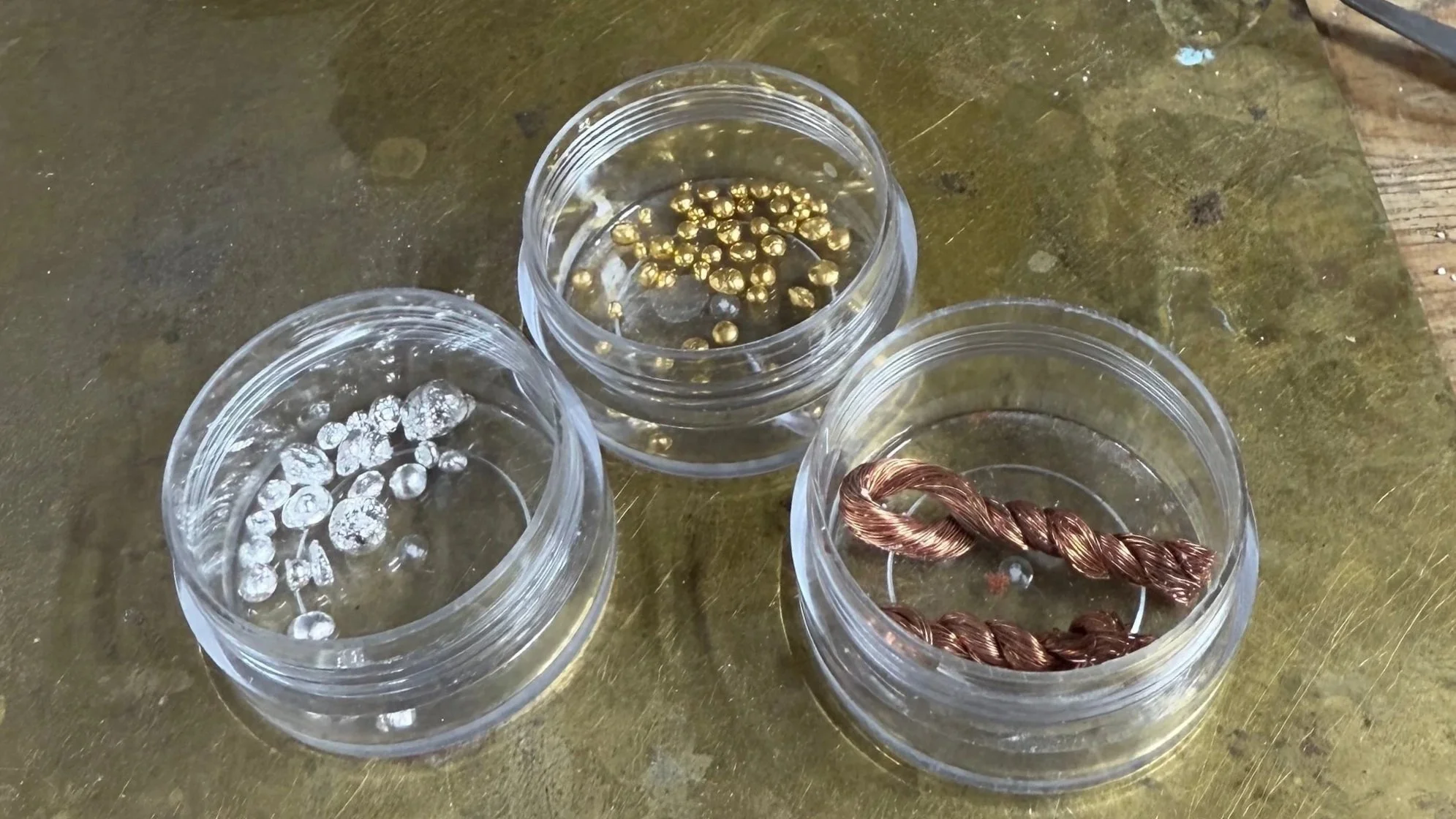
Raw fine (999) SMO Gold casting grain, fine (999) recycled silver and pure copper wire, waiting on my bench, to be alloyed into 14ct gold for a bespoke ring
Comparing the three routes
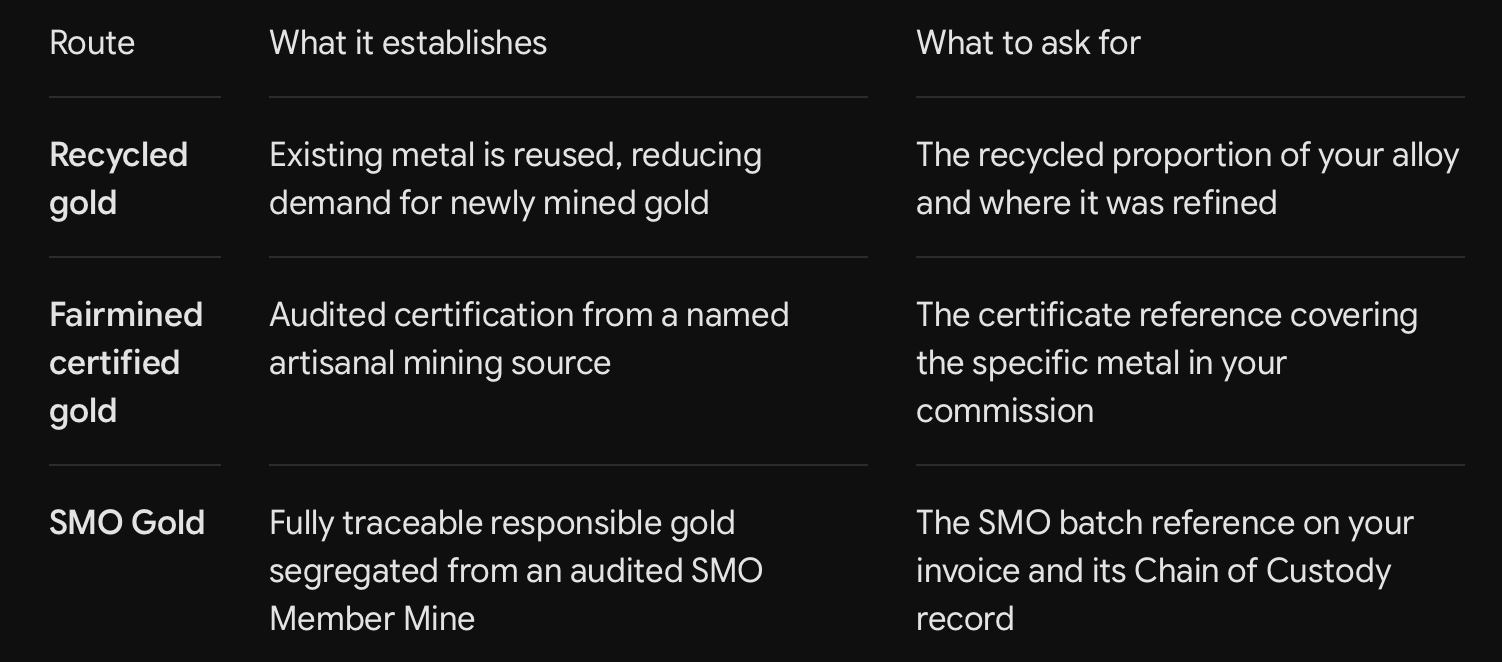
None of these routes is automatically superior in every circumstance. The right choice depends on whether your priority is reducing new extraction, supporting certified artisanal mining, or tracing your metal through a segregated Chain of Custody to an audited SMO Member Mine.
Ocean Diamonds and verified marine provenance
Unlike conventional diamonds extracted from inland open-pit or underground mines, Ocean Diamonds are natural diamonds washed from inland rock to the sea by rivers billions of years ago and recovered from shallow seabed gullies off the West Coast of South Africa.
Rather than relying on industrial deep-sea dredging, professional local divers work from small day-boats—or enter from the shoreline at low tide—in water depths of 0 to 12 metres, less than a kilometre offshore. Because divers can only enter the Atlantic on a select few days each month when ferocious storms clear and the swell settles, supply is inherently limited and recovery leaves minimal trace on the marine environment.
Because terms such as "ocean" or "sea-sourced" can be used loosely elsewhere in the jewellery trade, formal verification is what separates genuine marine provenance from marketing. Certified Ocean Diamonds provide clear documentation across three tiers:
Signed Certificate of Provenance: Every Ocean Diamond is accompanied by a signed Certificate of Provenance confirming its marine recovery, complete with a coastal location map.
GIA grading and girdle inscription (over 0.25ct): Every colourless cut Ocean Diamond weighing more than 0.25ct carries an individual Gemological Institute of America (GIA) report number laser-inscribed on its girdle.
Documented provenance on melee and raw stones: Diver-recovered melee diamonds (accent stones under 0.25ct) and uncut raw crystals carry documented assurance of their ocean origin rather than individual GIA girdle numbers.
Whichever diamond you select for a commission, ensure its origin and grading details are written directly onto your final invoice and your insurance valuation.
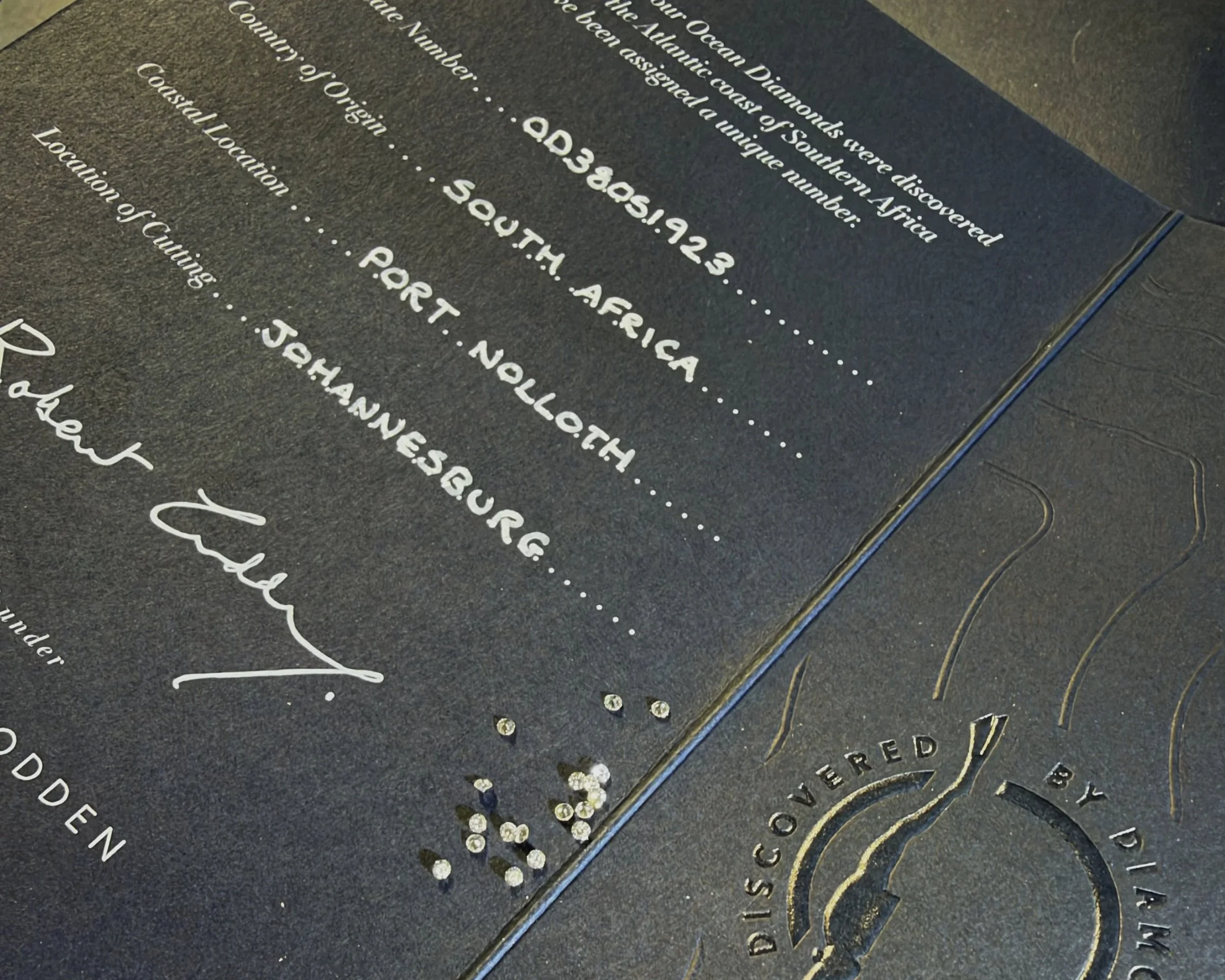
Melee Ocean Diamonds with their Certificate of Provenance showing the recovery location off the West Coast of South Africa and where they were cut.
Why a one-off commission makes traceability easier
When you buy a ready-made ring from a retail display case, the metal typically arrived in a large production batch serving dozens of pieces, with paperwork held only at bulk level. Commissioning a single piece changes that dynamic. Bullion and stones can be sourced specifically for your order, the origin recorded against your individual file, and the certificates handed over alongside the finished ring. The quantities are small, the chain of custody is short, and the person answering your questions is the goldsmith who melted, cast, and finished the metal.
Seven questions to ask before commissioning
Which sourcing route is used for the gold in my piece, and what documentary evidence supports it?
Will the metal's origin (and any SMO batch or certificate reference) be stated in writing on my invoice?
Where is the gold refined, and who alloys it to 18ct or 14ct?
What proportion of the alloy, if any, is recycled?
For diamonds and coloured gemstones, can you state the geographic origin and provide written provenance or grading certificates?
Can I review the relevant certificates or Chain of Custody documentation before confirming my commission rather than after?
How will my provenance paperwork be recorded for future valuations or remodelling?
A transparent maker will welcome these questions. Clear documentation - and honesty about where a paper trail stops - is always preferable to vague reassurance.
Where material provenance meets Sentimental Topography
Alongside documented material origin, there is a second kind of provenance that belongs uniquely to bespoke work:personal place. Through Sentimental Topography, sand gathered from a beach, headland, or landscape that holds meaning for you is used to form a single-use casting mould. When molten gold is cast against that sand, the metal captures the physical texture and grain of the terrain directly in its surface.
Those two records complement one another quietly. SMO Gold and certified Ocean Diamonds record where your materials came from on paper; the cast surface preserves where that special place is.
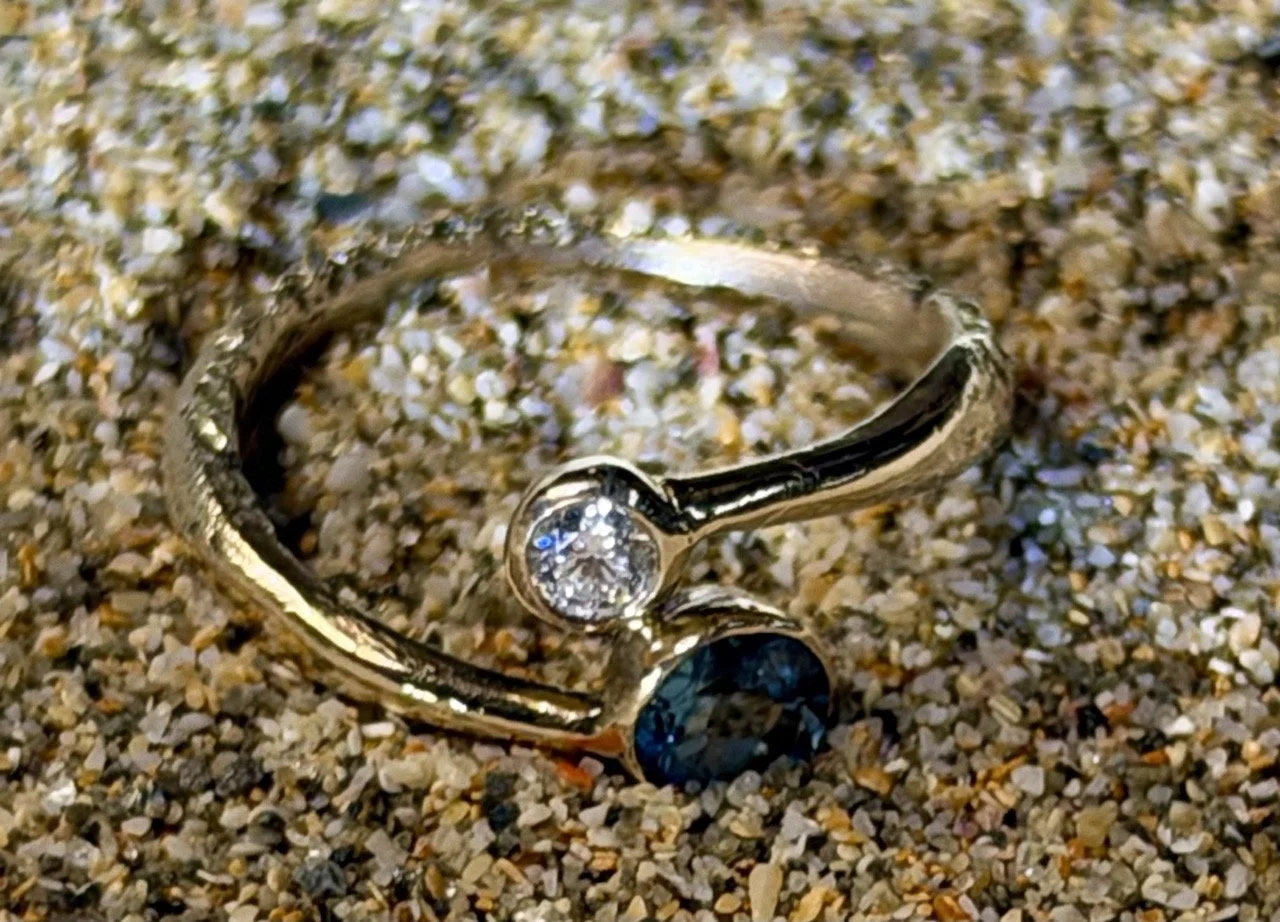
Cornish coastal sand surrounds a hand-cast SMO Gold ring with London Blue topaz and an Ocean Diamond, demonstrating Sentimental Topography sandcasting
Starting a bespoke commission
Bespoke commissions with Iain Sainsbury PhD start from £3,000 and begin with an unhurried consultation, either in person at his studio in Great Abington, just outside Cambridge, or remotely via video call anywhere in the UK. That initial conversation covers design direction, metal selection, gemstone sourcing, and the exact documentation that will accompany your piece.
Existing family gold can also be melted and reforged into a new wedding band, engagement ring, or signet. While remodelling heirloom metal keeps family history intact, old gold rarely arrives with original mine paperwork, although some information can be gleaned from a hallmark (if present) —so any formal origin certification applies to newly introduced SMO Gold or certified stones rather than the inherited alloy. Every piece is independently tested and hallmarked at a Edinburgh Assay Office.
Frequently Asked Questions
Is recycled gold the same as SMO Gold?
No. Recycled gold reuses existing bullion and lowers demand for newly mined metal, but because scrap and refining streams are pooled together, it cannot be traced back to a single mine. SMO Gold is segregated from extraction through refining and tracked via a Chain of Custody record back to an audited SMO Member Mine.
How can I verify an SMO Gold or Fairmined claim?
Ask your goldsmith to note the specific bullion route on your written quote and final invoice, and request the SMO batch reference and Chain of Custody documentation—or the Fairmined certificate number—covering the metal ordered for your commission.
What documentation comes with an Ocean Diamond?
Every Ocean Diamond comes with a signed Certificate of Provenance mapping its coastal origin off the West Coast of South Africa. In addition, every colourless cut stone over 0.25ct carries a GIA report number inscribed on its girdle, while smaller diver-recovered melee stones carry documented marine provenance assurance.
Can I combine my own heirloom gold with SMO Gold or Ocean Diamonds?
Yes. Heirloom family gold can be reforged into a new design and set with newly sourced Ocean Diamonds or paired with SMO Gold. Your invoice and valuation will distinguish clearly between your inherited family metal and any newly sourced materials.
Will the origin of my gold and stones appear on my valuation?
Yes. Alongside your UK Assay Office hallmark (in my case Edinburgh), your final invoice and insurance valuation should state the carat, metal route (such as 18ct SMO Gold), and gemstone provenance or GIA report numbers so that the record stays with the piece permanently.