In a world of mass-produced precision, there is something profoundly moving about the unpredictable. In my South Cambridgeshire studio, I often turn to one of the world’s oldest known crafts to create my jewellery: sand casting.
I call it "The Alchemy of Sand".
It is a process where the elemental meets the engineered, and where a handful of earth is transformed into a wearable legacy.

Goldsmith Iain Sainsbury pouring molten 18ct gold into a traditional sand-casting flask.
A Heritage Forged in Fire
Casting is not a new innovation; it is a shared human history. Whilst the modern jewellery industry relies heavily on 3D printing and reusable rubber moulds - technologies that allow for thousands of identical pieces - sand-casting remains a defiant, singular act.
The roots of this craft stretch back to 4000 BCE. From the copper frogs of ancient Mesopotamia to the Bronze Age weapons of our ancestors, humans have always sought to capture the fluidity of molten metal within the grit of the earth. By choosing sand-casting today, we are participating in a ritual that has remained largely unchanged for six millennia.
The Process: From Sentiment to Structure
Unlike modern "lost wax" casting, which produces an exact, polished replica, sand-casting is a destructive process. Each mould is created for one pour, and once the metal hits the sand, the mould is destroyed. This ensures that every piece I create is physically impossible to replicate.
Before we begin the ritual of the forge, you may wish to prepare your coordinates by downloading The Alchemist’s Guide for gathering your landscape.
The technique requires both discipline and an embrace of the organic:
The Impression: I begin with a "former" - a model of the design carved in wax or wood, or sometimes in silver. This is pressed into a specialised casting flask filled with Delft clay (a fine, mineral oil enriched sand).
The Landscape: This is where the alchemy truly happens. I often adapt the clay with sand provided by my clients, or from my own stocks. Whether it is grit from a mountain trail or sand from the beach where a proposal took place, this sediment becomes the very texture of the metal.
The Pour: Molten SMO gold or recycled silver is poured into the hand formed channels. As the metal cools, it takes on the “textural memory” of the sand, capturing every grain and ripple.
The Reveal: The flask is opened, the burnt sand is left behind and brushed away, and a unique piece of "sentimental topography" is born.
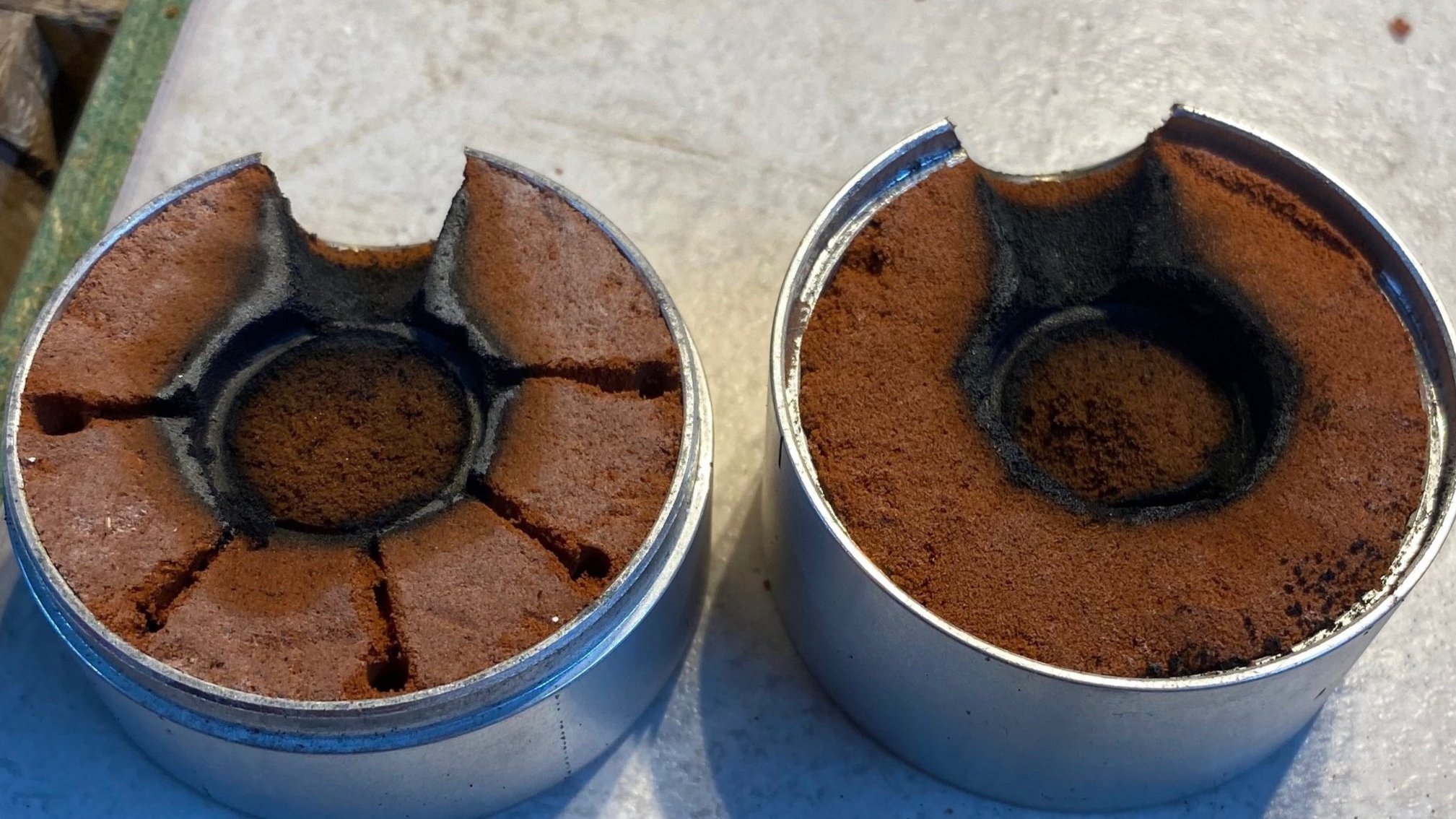
The destroyed sand mould after a unique casting, showing the burnt texture, no two casts are the same, each unique to you
Why Sand-Casting?
If you look closely at a piece from my ATOMIUM collection, you will see the tension that defines my work. The crisp, geometric lines of Brutalist architecture are juxtaposed against the raw, pitted texture of the sand-cast band.

Bespoke architectural ring from the NAJ Finalist ATOMIUM collection featuring raw sand-cast textures and polished geometric faces of the sapphire, spinel and diamond
I choose this method because:
It is Authentic: It cannot be faked by a machine. It requires the hand and the eye of the artisan.
It is Textural: It achieves a rugged, organic finish that lost-wax casting simply cannot replicate.
It is Yours: When I use sand from a place that matters to you, the jewellery ceases to be mere adornment. It becomes a physical record of your history.
Your Story, Cast in Gold
Whether you are looking for an engagement ring that carries the essence of a specific coastline or a piece of sculptural jewellery that balances modern design with ancient technique, sand-casting offers a depth that goes beyond the surface.
Are you ready to cast your own story? Let’s discuss how we can incorporate the landscape of your life into a one-of-a-kind creation.